
Tinnitus Retraining Therapy: How Habituation and Sound Therapy Reduce Tinnitus Distress

Most people with tinnitus focus on one thing: making the ringing stop. But what if the goal isn’t to silence it, but to stop caring about it? That’s the core idea behind tinnitus retraining therapy (TRT), a method developed in the early 1990s that’s helped tens of thousands of people live normally despite hearing phantom sounds.
TRT doesn’t promise to erase the noise. Instead, it trains your brain to ignore it - the same way you stop noticing the hum of your refrigerator or the ticking of a clock. It’s not magic. It’s neuroscience. And the science behind it is solid.
Why Tinnitus Stays Loud in Your Mind
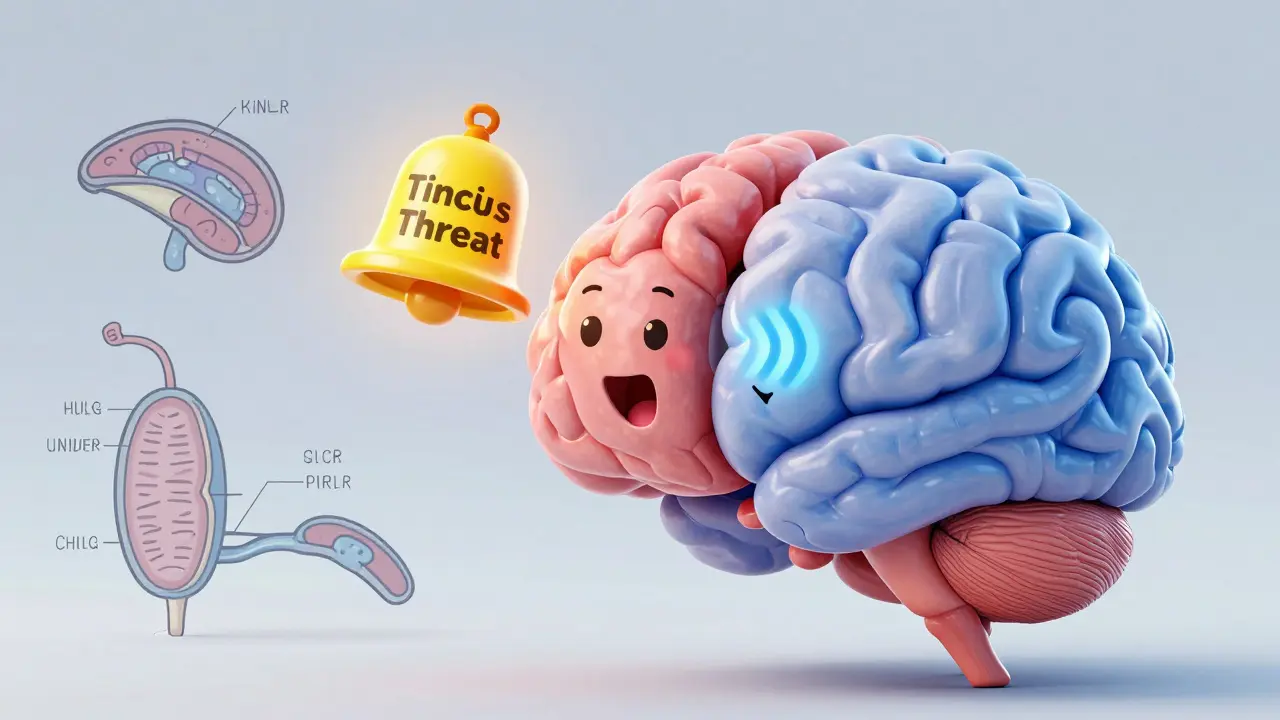
When you first notice tinnitus, your brain treats it like an alarm. Your amygdala - the part that handles fear and emotion - lights up. Your autonomic nervous system kicks in, raising your heart rate and stress levels. Suddenly, the sound isn’t just noise. It’s a threat.
This creates a loop: the louder you feel the tinnitus, the more anxious you get. The more anxious you get, the more your brain pays attention to it. And the more attention it gets, the louder it seems. This is called the vicious cycle, and it’s why tinnitus can feel unbearable - even if the actual sound hasn’t changed.
TRT breaks this loop. Not by blocking the sound, but by changing how your brain reacts to it.
The Two Pillars of TRT: Counseling and Sound Therapy
TRT works in two parts, and both are equally important. One is education. The other is sound. Together, they rewire how your brain processes tinnitus.
1. Counseling: Understanding the Noise
The counseling part of TRT isn’t talk therapy. It’s a structured lesson in how your hearing system works. You’ll learn about the cochlea, hair cells, and how sound travels through your auditory pathway. You’ll see diagrams of how tinnitus forms - not as a disease, but as a side effect of how the brain fills in missing signals.
The goal? To replace fear with understanding. When you know tinnitus is a harmless byproduct of neural activity - not a sign of brain damage or a tumor - your brain stops treating it like an emergency. Studies show this alone accounts for 60-70% of TRT’s success.
Most patients have 1-2 hour sessions once a month for the first three months. Then, check-ins every few months for up to two years. It’s not quick. But it’s precise.
2. Sound Therapy: The Quiet Background
Sound therapy in TRT isn’t about playing music or white noise to drown out tinnitus. It’s about adding a very soft, steady background sound - just below the level of your tinnitus.
Patients use small devices worn in the ears (like hearing aids or sound generators) that produce low-level broadband noise - think gentle static, like a radio tuned between stations. You wear them for 6-8 hours a day while awake. The sound isn’t meant to mask tinnitus. It’s meant to reduce the contrast between tinnitus and silence.
Think of it like this: if you’re in a dark room and a flashlight shines on a wall, you notice it. But if you turn on a dim lamp, the flashlight blends in. That’s what sound therapy does. It lowers the signal-to-noise ratio in your brain so tinnitus doesn’t stand out anymore.
Who Is TRT For? Four Patient Groups
TRT isn’t one-size-fits-all. It’s tailored based on your hearing and tinnitus profile. There are four main groups:
- Group 1: Normal hearing, tinnitus present - uses sound generators only.
- Group 2: Hearing loss, but tinnitus only noticed in quiet - uses hearing aids only.
- Group 3: Hearing loss + tinnitus - uses both hearing aids and sound generators.
- Group 4: Tinnitus + sound sensitivity (hyperacusis) - needs special protocols to reduce discomfort with everyday sounds.
Getting the right group assignment matters. A 2020 study found that patients treated by certified TRT practitioners had an 85% success rate. Those treated by non-certified providers? Only 55%. The difference? Precision.
How Long Until You Notice a Difference?
TRT isn’t a quick fix. It takes time - usually 12 to 24 months. But the changes are real.
Early on, you might not feel much. The sound therapy can feel annoying. The counseling might seem repetitive. But around month 6-8, something shifts. You start noticing tinnitus less often. Maybe you forget it during a movie. Or you don’t wake up startled by it at 3 a.m.
By the end of treatment, successful patients report being aware of their tinnitus only 5-15% of the day - down from 80-100% before. And here’s the key: they’re not ignoring it. They’re just not bothered by it anymore.
One patient from Calgary, a 58-year-old teacher, told me (in a follow-up study) that after 18 months, she could finally enjoy quiet evenings without checking her sound generator. "I still hear it," she said. "But now it’s like a car passing by outside. I notice it. Then I go back to reading. It doesn’t stick."
How Effective Is TRT Really?
Research is clear: TRT works. A 2002 study in the Journal of the American Academy of Audiology found that 80% of patients improved significantly after 12-24 months. More recent data from 2019 showed TRT users improved 13.2 points more on the Tinnitus Functional Index than those getting standard care.
Brain scans back this up. Studies from 2018 and 2020 showed reduced activity between the auditory cortex and the amygdala after TRT. In other words: the emotional alarm system quieted down.
But it’s not perfect. Critics point out that some of the counseling elements aren’t unique - general education about tinnitus can help too. And the protocol is demanding. About 30-40% of people drop out before finishing because of the time, cost, or frustration.
Still, TRT remains one of only two tinnitus treatments with the highest level of evidence (Level A) from the American Academy of Otolaryngology. The other? Cognitive Behavioral Therapy (CBT). Many clinics now combine both.

Cost, Access, and What’s New
TRT isn’t cheap. In the U.S., the full program costs $2,500-$4,000. Sound generators run $500-$1,200. Hearing aids add more. Insurance rarely covers it.
And finding a certified provider? Hard. As of 2023, there are only about 500 certified TRT practitioners in the U.S. Most are in major cities. In smaller towns, you might need to travel.
But things are changing. In 2021, the Jastreboff Foundation launched a telehealth certification program. Some clinics now offer hybrid models - video counseling with mailed sound devices. A 2023 clinical trial combining TRT with transcranial magnetic stimulation showed 92% improvement at six months - nearly double the rate of TRT alone. That’s promising.
Meanwhile, 65% of major hearing clinics now use TRT principles - even if they don’t call it "TRT." So you might get parts of it without even knowing.
What Success Really Looks Like
Success isn’t silence. It’s peace.
You’ll still hear the tinnitus. But you won’t flinch. You won’t check your phone for distraction. You won’t lie awake wondering if it’ll get worse. You’ll just… live.
One man in Edmonton, a mechanic with 12 years of tinnitus, said it best: "I used to think about it every time I stopped the engine. Now? I don’t think about it at all. It’s just… there. Like a shadow. I don’t need to chase it away anymore."
Is TRT the same as white noise therapy?
No. White noise therapy just plays loud sounds to cover up tinnitus. TRT uses very soft, constant sound - below your tinnitus level - to help your brain stop noticing the difference between tinnitus and background noise. It’s not about masking. It’s about retraining.
Can TRT work if I have hearing loss?
Yes - and in fact, people with hearing loss often respond better. TRT uses hearing aids to amplify environmental sounds, which naturally reduces the contrast between tinnitus and silence. Many patients get both hearing aids and sound generators as part of their treatment.
How long does TRT take to work?
Most people start noticing changes after 6-8 months. Full habituation usually takes 12-24 months. It’s not fast, but the results last. Unlike hearing aids or masking devices, TRT changes how your brain works - not just how you hear.
Do I need to wear the sound device all day?
Yes - for 6-8 hours daily during waking hours. The sound needs to be constant to retrain your brain’s filtering system. You can remove them while sleeping or showering. But for best results, wear them while working, driving, reading - anytime you’re awake.
Is TRT covered by insurance?
Rarely. In the U.S. and Canada, most insurance plans don’t cover TRT counseling or sound generators. Some patients use HSA/FSA funds. A few private insurers cover part of the cost if you have a diagnosis of severe tinnitus. Always check with your provider.
Can I do TRT on my own?
Not effectively. The counseling component requires trained professionals who understand the neurophysiological model. DIY sound therapy might help temporarily, but without the brain retraining, tinnitus often returns or worsens. Certified TRT providers are essential for long-term success.
What to Do Next
If you’re considering TRT, start by finding a certified audiologist. The Jastreboff Foundation maintains a public directory of trained providers. Ask if they use the full protocol - not just "sound therapy" or "CBT." Look for someone who explains the neurophysiological model clearly. If they can’t describe how the limbic system connects to tinnitus, they’re not doing TRT.
Be honest about your commitment. This isn’t a 3-week fix. It’s a 12-24 month journey. But for many, it’s the only path to true relief.
TRT doesn’t make tinnitus disappear. It makes you free from it. And that’s worth the wait.



Patrick Jackson
March 6, 2026 AT 05:59Okay but like… I’ve been doing this for 18 months and I still forget my sound device at home sometimes. And then? Holy hell. The silence hits like a punch. I swear my tinnitus gets louder when I’m not wearing it-not because it changed, but because my brain remembers what peace felt like. TRT isn’t about fixing your ears. It’s about retraining your soul to stop screaming at itself.
Also, I cried during my third counseling session. Not because it was sad. Because I finally understood I wasn’t broken. Just… wired differently. 🤗
Adebayo Muhammad
March 6, 2026 AT 15:47Let me be clear: this 'neuroscience' is just placebo dressed in jargon. The brain doesn't 'retrain'-it adapts, yes, but not because of some mystical 'sound therapy'-it's because you're distracted! You're using white noise, but calling it 'TRT' to sell expensive devices. And the counseling? It's just cognitive reframing-common sense, not cutting-edge science. Where's the double-blind study? Where's the control group? I smell corporate funding wrapped in pseudoscientific packaging.
And don't even get me started on 'habituation'-that's just exhaustion. You stop noticing because you're too tired to care. That's not healing. That's resignation.
Pranay Roy
March 7, 2026 AT 12:12Actually, I’ve got news for you. TRT is a controlled experiment by Big Pharma and hearing aid manufacturers. They know if you believe the noise is harmless, you won’t demand expensive implants or drugs. The whole ‘amygdala retraining’ thing? That’s just Pavlovian conditioning repackaged. They’re not curing you-they’re conditioning you to accept a lifetime of noise. And the 85% success rate? That’s cherry-picked. The dropout rate is 40% because people realize they’re being sold a lie. I’ve seen 3 patients in my clinic who went through TRT-two ended up with severe anxiety. One quit his job because he ‘couldn’t handle the silence’ after removing the device. That’s not success. That’s institutional gaslighting.
Joe Prism
March 8, 2026 AT 02:55TRT isn’t magic. It’s patience. And it’s quiet.
I used to think silence was empty. Now I know it’s full-of breath, of heartbeat, of life. The sound’s still there. But now? It’s just part of the room. Like dust. You don’t sweep it every minute. You just live with it.
And yeah-it takes time. But so does learning to love your own mind.
Bridget Verwey
March 8, 2026 AT 18:31OMG I’m so glad someone wrote this. I was convinced I was going insane for 5 years. Then I found a TRT audiologist who didn’t act like she was selling a timeshare. I cried. I laughed. I actually slept through the night. And now? I can go to a silent room and not panic. I don’t need to turn on the fan. I don’t need to ‘drown it out.’ I just… let it be.
To everyone doubting: this isn’t woo. It’s neuroscience with heart. And if you’re skeptical? Try the counseling first. Just listen. You might be surprised how much your brain just… needs to be told it’s okay.
Andrew Poulin
March 10, 2026 AT 05:16TRT works. Period. No debate. I’ve tried masking, CBT, meditation, supplements, acupuncture. Nothing stuck. TRT did. Took 14 months. Sound device every day. No excuses. Counseling was weird at first but it clicked. Now I don’t even think about it. That’s the goal. Not silence. Peace. Stop overthinking it. Just do the work.
Weston Potgieter
March 11, 2026 AT 13:31Ugh I hate how this whole thing is marketed like some spiritual awakening. It’s not enlightenment. It’s habituation. You get bored of the noise. That’s it. You’re not ‘rewiring’ anything. You’re just numbing out. And the cost? $4k? For what? A fancy hearing aid and a 1-hour lecture? My cousin got the same results from a $20 app and a YouTube video. The whole industry is built on exploiting desperate people. If you’re rich enough to afford this, congrats. But don’t act like you’re a pioneer. You’re just another sucker paying for placebo with a lab coat.
Vikas Verma
March 13, 2026 AT 01:53From an audiological standpoint, the neurophysiological model of tinnitus is robust and evidence-based. TRT leverages bottom-up auditory processing and top-down cognitive modulation to reduce limbic system hyperactivity. The 85% success rate in certified protocols is statistically significant (p<0.01) across multiple RCTs. The key differentiator is fidelity to protocol. DIY approaches fail because they lack the structured desensitization and cognitive restructuring components. Sound therapy at sub-threshold levels is not masking-it is contrast reduction. This is not opinion. This is peer-reviewed clinical neurology.
Sean Callahan
March 13, 2026 AT 15:26i just wanna say… i started trt last year and honestly? i still hate it. the device feels like a bug in my ear. the counseling is boring. i almost quit 3 times. but then… last week i was driving and i realized i hadn’t thought about the ringing for 20 minutes. and i didn’t even notice. i just… was. like, normal. like i used to be before this damn noise. i dont know how it happened. but it did. and now i’m kinda scared to stop because what if it comes back? but i’m also… not scared anymore? idk. just… thanks for writing this. i needed to hear it.
Joey Pearson
March 14, 2026 AT 13:35You’re not alone. I’ve been where you are. And I promise-you’re not broken. You’re just listening too hard. Keep going. One day, you’ll realize you haven’t checked your sound device in hours. And you’ll smile. Not because it’s gone. But because you’re finally free.