
Antihistamines and Occupational Safety: Working While Drowsy

Antihistamine Safety Checker
Check Your Antihistamine Safety
Enter the name or active ingredient of your allergy medication to determine if it's safe for work.
Every year, thousands of workers show up to their jobs feeling perfectly fine-no yawning, no rubbing eyes, no signs of tiredness. But their brains aren’t working right. Their reactions are slow. Their focus is blurry. And they don’t even know it. This isn’t a case of poor sleep or burnout. It’s often caused by something many people take without a second thought: first-generation antihistamines.
These are the old-school allergy pills like Benadryl, Chlor-Trimeton, and Atarax. They work great for sneezing and runny noses. But they also slip right into your brain. And once they’re in, they mess with histamine, a chemical your brain uses to stay awake. That’s why you feel drowsy. The scary part? You might not feel it at all.
How Antihistamines Really Affect Your Brain
Not all antihistamines are the same. There are two main types: first-generation and second-generation. The difference isn’t just in price or brand-it’s in how they interact with your body.
First-generation antihistamines like diphenhydramine and chlorpheniramine are lipophilic. That means they’re fat-soluble. This lets them easily pass through the blood-brain barrier. Once inside, they block histamine receptors in areas of the brain that control alertness. The result? Slowed thinking, delayed reaction times, and poor coordination. Studies show these drugs can reduce reaction speed by 25-30% and increase lane drifting in driving simulators by 50%. That’s worse than being at the legal alcohol limit in many places.
Second-generation antihistamines-loratadine (Claritin), cetirizine (Zyrtec), and fexofenadine (Allegra)-were designed differently. They’re built to be pumped out of the brain by a protein called P-glycoprotein. This keeps them mostly outside the central nervous system. In tests, their effects on cognitive performance are nearly identical to a placebo. No real drop in focus. No measurable delay in response.
The FDA requires warning labels on first-generation antihistamines: “May cause drowsiness. Avoid driving or operating machinery.” But how many people actually read those? A 2022 analysis found that only 43% of first-generation product leaflets include clear timing advice. Meanwhile, 87% of second-generation labels do. The gap isn’t just in labeling-it’s in awareness.
Why You Don’t Feel Drowsy-But Still Can’t Work Safely
Here’s the trick: drowsiness isn’t always obvious. Some people don’t feel sleepy, but their brain is still impaired. A truck driver on Reddit described failing a roadside cognitive test after taking Benadryl. “I didn’t feel tired,” he wrote. “But I couldn’t touch my nose with my finger. That’s when I knew something was wrong.”
This disconnect between perception and reality is dangerous. Workers in construction, manufacturing, and transportation often assume they’re fine because they’re not yawning. But their motor skills, judgment, and attention span are compromised. The National Highway Traffic Safety Administration estimates 100,000 car crashes each year are linked to drowsiness. Many of those involve medications-not alcohol.
It gets worse. First-generation antihistamines have long half-lives. Diphenhydramine sticks around for 15 to 30 hours. That means if you take it at noon, you might still be impaired at midnight. And if you take it twice a day? The effects build up. One study found 37% of users reported next-day grogginess-even when they didn’t take it the night before.
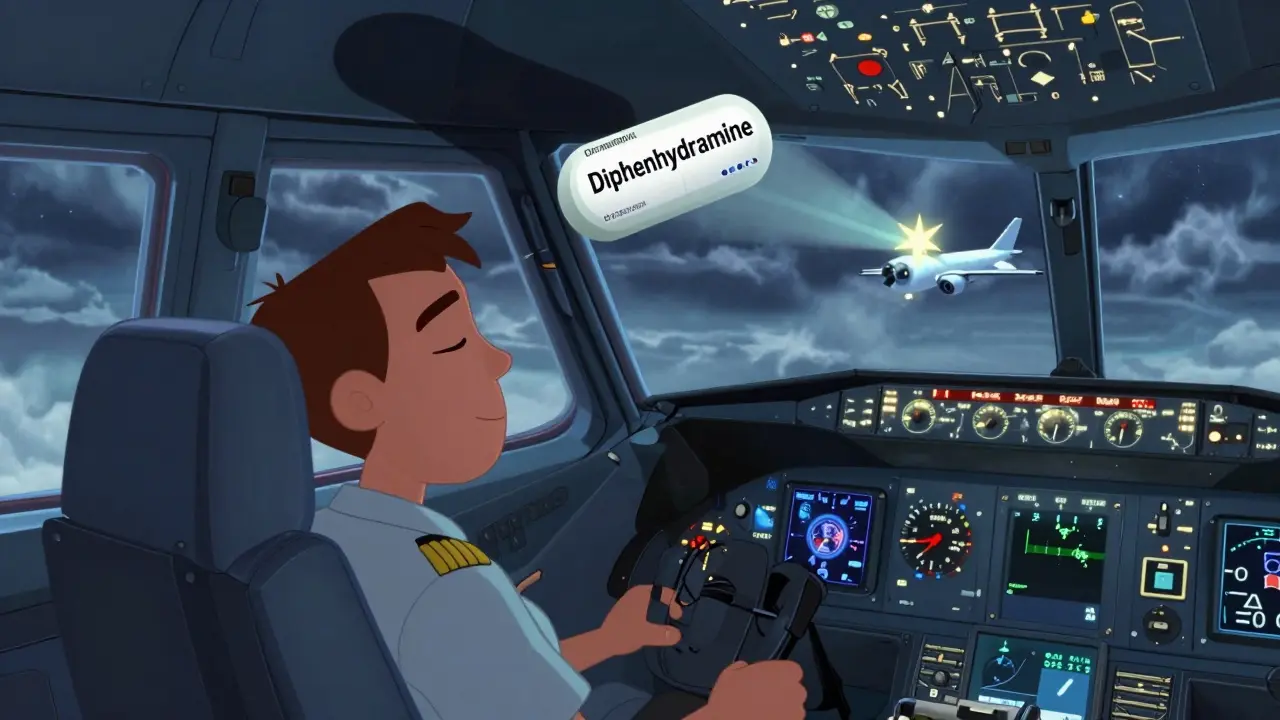
Who’s at Risk? It’s Not Just Drivers
Most people think this is about driving. But it’s bigger than that.
Aviation safety reports show first-generation antihistamines are the leading medication found in pilot crash autopsies. The FAA explicitly bans them for pilots. The Department of Transportation requires employers in transportation to include antihistamine use in safety training. Why? Because a pilot, train operator, or crane worker who can’t react fast enough doesn’t just hurt themselves-they risk dozens of lives.
Construction workers using ladders or operating heavy machinery are also at risk. The CDC says more than one in four older adults fall each year. First-generation antihistamines increase that risk. Falls lead to fractures, hospital stays, and long-term disability. A nurse in Calgary told me her colleague broke her hip after taking diphenhydramine for allergies, then slipped while climbing a step stool. “She thought she was fine,” the nurse said. “She didn’t feel dizzy. But her balance was shot.”
Even office workers aren’t safe. Poor concentration leads to mistakes in data entry, missed deadlines, and miscommunication. A 2023 survey found 28% of workers who took sedating antihistamines reported difficulty operating machinery-even when they didn’t feel sleepy.
The Clear Choice: Switch to Non-Sedating Options
The good news? You don’t have to choose between allergy relief and safety.
Second-generation antihistamines work just as well for allergies-with far fewer side effects. Loratadine, cetirizine, and fexofenadine are widely available over the counter. They’re cheaper than ever. And they don’t wreck your brain.
Here’s what the data says:
- 78% of Allegra users report no drowsiness
- Only 12% of Benadryl users say the same
- 73% of nurses now use non-sedating antihistamines exclusively
- Second-gen options show no measurable impairment in driving or psychomotor tests
Even newer drugs like bilastine-used widely in Europe and Canada-show excellent safety profiles. Studies confirm they don’t impair performance even at double the dose. They’re not yet available everywhere, but the trend is clear: medicine is moving away from brain-slowing antihistamines.

What You Should Do-Right Now
If you take antihistamines regularly for allergies-or use them as a sleep aid-ask yourself this: Which kind are you using?
Check the label. If it says “diphenhydramine,” “chlorpheniramine,” or “hydroxyzine,” you’re on a first-generation drug. Switch. Don’t wait for an accident. Don’t wait to feel tired. Just switch.
Here’s how:
- Look at your current allergy med. Find the active ingredient.
- Replace it with loratadine, cetirizine, or fexofenadine. They’re all available without a prescription.
- Try the new one at home first. Take it on a weekend. See how you feel. Do you still have energy? Can you focus? If yes, it’s safe for work.
- Wait at least 8-12 hours after taking a first-generation antihistamine before operating machinery or driving. For some people, 24 hours is safer.
- Never mix antihistamines with alcohol. That combo multiplies impairment. It’s not a myth-it’s a proven risk.
Employers are catching on too. As of 2023, 41% of Fortune 500 companies have added antihistamine guidelines to their safety policies. That’s not just policy-it’s prevention.
What’s Next? Regulation Is Coming
The FDA updated antihistamine labels in March 2023 to include stronger warnings about occupational impairment. NIOSH launched a 2024 initiative to create workplace safety guidelines. The European Union already restricts sedating antihistamines for transport workers.
It’s only a matter of time before more industries require non-sedating alternatives. In fact, experts predict that by 2030, workers in safety-sensitive jobs may be required to use only second-generation antihistamines. That’s 23 million people in the U.S. alone.
Don’t wait for a rule to change your habits. Change them now. Your brain, your coworkers, and your family will thank you.
Can I still use Benadryl if I take it at night?
Taking Benadryl at night doesn’t make it safe for daytime work. First-generation antihistamines like diphenhydramine have a half-life of 15-30 hours. That means even if you take it at bedtime, you could still be impaired the next day. Studies show 37% of users report next-day drowsiness or brain fog. If your job requires focus, alertness, or physical coordination-even if you work the day shift-you should avoid it entirely.
Are all over-the-counter allergy pills sedating?
No. Many OTC allergy meds are second-generation and non-sedating. Look for the active ingredients: loratadine (Claritin), cetirizine (Zyrtec), or fexofenadine (Allegra). These are designed to avoid brain penetration. Avoid anything with diphenhydramine, chlorpheniramine, or hydroxyzine-even if it’s labeled "non-drowsy" on the front. Those claims can be misleading. Always check the ingredient list.
I’m a truck driver. Is it illegal to drive after taking an antihistamine?
It’s not illegal to take antihistamines, but driving while impaired by them is. Under U.S. DOT rules, any drug that affects your ability to operate a vehicle safely can lead to charges of drugged driving-even if it’s legal and prescribed. Police can test for antihistamines during roadside screenings. A 2021 case in Alberta involved a commercial driver who failed a field sobriety test after taking Benadryl. He was cited for impaired driving. No alcohol involved.
Do second-generation antihistamines work as well as first-generation ones?
Yes. Multiple clinical trials confirm that loratadine, cetirizine, and fexofenadine are just as effective at blocking histamine and relieving allergy symptoms like sneezing, runny nose, and itchy eyes. The only difference is they don’t cross into your brain. You get the same relief without the drowsiness, poor coordination, or delayed reaction time.
Can I mix antihistamines with alcohol?
Never. Mixing alcohol with first-generation antihistamines is extremely dangerous. Both are CNS depressants. Together, they can multiply drowsiness, slow your breathing, and severely impair coordination. Even one drink with a dose of Benadryl can make you as impaired as someone with a 0.08% blood alcohol level. The FDA label warns about this. So do the FAA, DOT, and NIOSH. It’s not a risk worth taking.




Nandini Wagh
February 25, 2026 AT 18:26tia novialiswati
February 26, 2026 AT 22:56Christina VanOsdol
February 27, 2026 AT 07:43Alfred Noble
March 1, 2026 AT 02:29Christopher Brown
March 3, 2026 AT 02:25Jacob Carthy
March 3, 2026 AT 18:51Lillian Knezek
March 4, 2026 AT 15:07Emily Wolff
March 4, 2026 AT 17:11Lisandra Lautert
March 5, 2026 AT 12:37Michael FItzpatrick
March 6, 2026 AT 06:54Maranda Najar
March 7, 2026 AT 07:40Gwen Vincent
March 8, 2026 AT 14:33Matthew Brooker
March 10, 2026 AT 06:41