
Therapeutic Equivalence Codes: How the FDA Determines If Generic Drugs Can Be Swapped
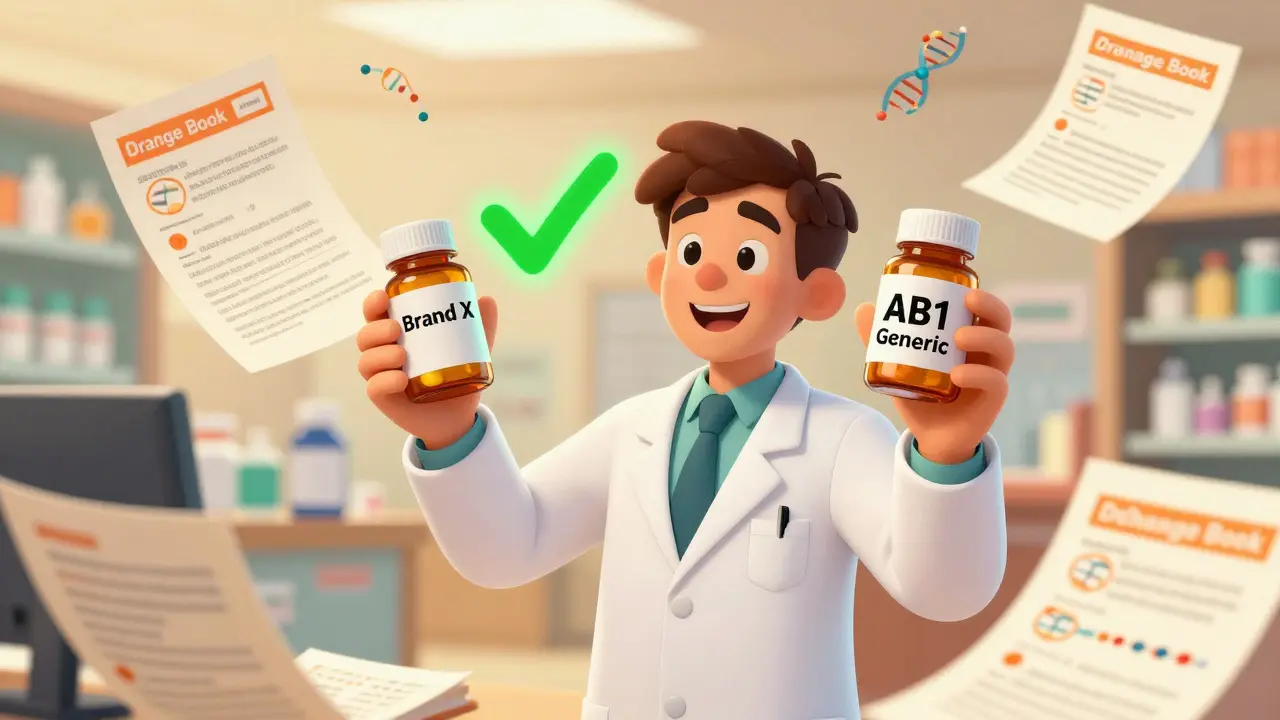
When your pharmacist hands you a generic pill instead of the brand-name version, you might not think twice. But behind that simple swap is a detailed, science-backed system the FDA uses to decide if it’s safe to substitute one drug for another. That system? Therapeutic equivalence codes. These aren’t just letters on a label-they’re the key to saving billions in healthcare costs while keeping patients safe.
What Therapeutic Equivalence Codes Actually Mean
Therapeutic equivalence codes are the FDA’s way of saying, ‘This generic drug works just like the brand-name version.’ They appear in the Approved Drug Products with Therapeutic Equivalence Evaluations, better known as the Orange Book. First published in 1980, this guide is updated monthly and lists every approved drug in the U.S.-and whether it can be swapped out without changing how well it works.
The code starts with a single letter: A or B. That’s it. But what that letter tells you is huge.
If a drug has an A code, it means the FDA has confirmed it’s therapeutically equivalent to the brand-name drug. That means it has the same active ingredient, strength, dosage form, and route of administration-and it’s been proven through testing to deliver the same results in the body. For most people, this means the generic can be swapped automatically, no doctor’s note needed.
If it has a B code, the FDA says: ‘We don’t have enough proof yet.’ That doesn’t mean it’s unsafe. It just means the data isn’t clear enough to guarantee it behaves the same way in the body. Maybe the drug is an extended-release capsule, a topical cream, or an inhaler. These are harder to test. So the FDA flags them until more evidence comes in.
The A Codes: What AB1, AB2, AB3, and AB4 Mean
Not all A codes are the same. The FDA adds numbers after the A to handle situations where multiple brand-name drugs exist for the same condition. For example:
- AB1 means this generic matches the first approved brand-name version.
- AB2 means it matches a different brand-name version, even if they’re both approved for the same use.
- AB3 and AB4 follow the same pattern.
Why does this matter? Because two brand-name drugs might have different inactive ingredients or release profiles. Even if both are effective, a generic might only be proven equivalent to one of them. If your doctor prescribes the brand with AB2, and your pharmacist gives you a generic marked AB1, it could be a mismatch-even though both generics are labeled ‘A’.
Pharmacists are trained to check these sub-codes. Skipping this step could mean giving you a drug that works fine for most people-but not for your specific condition.
The B Codes: Why Some Generics Are Flagged
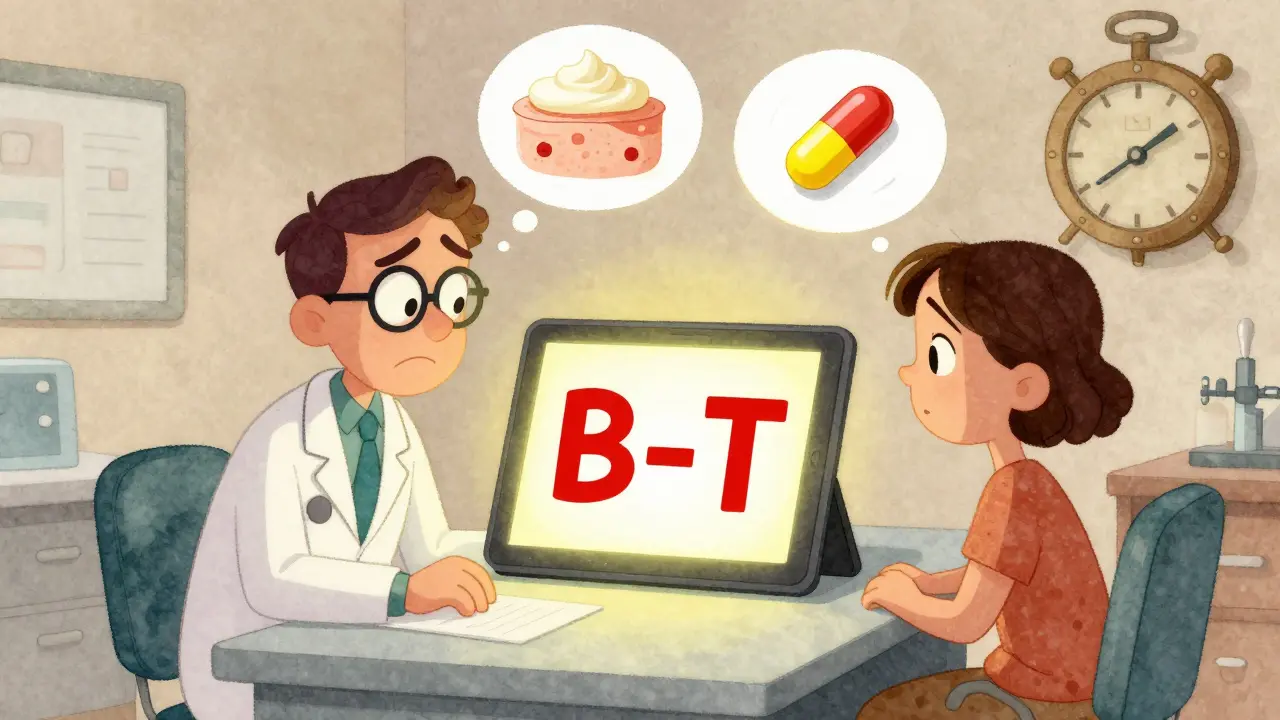
Let’s say you’re prescribed a topical cream for eczema. The generic version has a B code-maybe BT or BC. You might think, ‘Why won’t my pharmacist substitute it?’
Here’s the truth: Many B-coded drugs are perfectly safe. But the FDA can’t prove they’re equivalent using standard blood tests. For example:
- BT = Topical products with bioequivalence issues
- BC = Extended-release forms that don’t release the drug the same way
- BD = Active ingredients with known bioequivalence problems
- BN = Aerosol or nebulizer drugs
- BX = Not enough data to judge
These aren’t failures. They’re flags. The FDA doesn’t have good ways to test how a cream absorbs through skin or how a slow-release pill behaves over 12 hours. So they say, ‘We don’t know for sure yet.’
But here’s the catch: Many doctors and pharmacists don’t understand the difference between ‘B’ and ‘unsafe.’ A 2022 AMA survey found that 42% of physicians were confused about B codes. Some refused to let pharmacists substitute them-even when the drug was clinically appropriate. Others assumed B meant ‘don’t use,’ when it really meant ‘need more data.’
Why This System Works-And Why It’s Under Pressure
The FDA’s system has worked well for decades. In 2023, over 90% of the 14,000 drugs listed in the Orange Book had an A rating. That’s why 90% of prescriptions filled in the U.S. are generics-and why they save $370 billion a year.
But the system was built for simple pills and injections. Today, we have complex drugs: biologics, inhalers, transdermal patches, and long-acting injectables. These aren’t easy to test. A blood test might show the same amount of drug in your system-but not whether it’s working the same way over time.
That’s why the FDA released a draft guidance in 2022 proposing updates. They’re exploring new ways to evaluate these drugs, like using real-world data from patient records or advanced lab models. Right now, 22% more B-coded applications for complex generics are being submitted than in 2018. The FDA wants to reduce that number by 30% by 2027.
How Pharmacists Use These Codes Every Day
When you hand over a prescription, your pharmacist doesn’t just grab the cheapest option. They check the Orange Book. They look up the drug name, strength, and manufacturer. Then they match it to the TE code.
If it’s an A-rated drug, they can substitute it without asking your doctor. In 49 states, that’s legal. In fact, 87% of pharmacists say TE codes make their job easier, according to a 2022 survey by the National Community Pharmacists Association.
But if it’s a B-rated drug? They have to stop. Some states require them to notify your doctor before substituting. Others say no substitution at all. That’s why you might get the brand name even if a generic exists.
On average, pharmacists spend 2.7 minutes per prescription verifying TE codes. That adds up. But it’s worth it. Without this system, we’d be paying $1.2 billion more every year just for the same treatments.

What You Should Know as a Patient
You don’t need to memorize AB1 or BT. But you should know this:
- If your generic is labeled ‘A,’ it’s safe to swap. No need to worry.
- If it’s labeled ‘B,’ ask your pharmacist: ‘Is this because we don’t have enough data-or because it’s not safe?’
- Don’t assume a B code means ‘don’t use.’ It might just mean ‘need more study.’
- Always check the label. The TE code isn’t printed on the bottle, but the pharmacy’s system tracks it.
- If you notice a change in how you feel after switching to a generic-especially with a B-rated drug-tell your doctor.
The FDA doesn’t want you to guess. They want you to trust. And the system, for all its flaws, has kept millions of Americans safe while cutting drug costs.
What’s Next for Therapeutic Equivalence Codes
The FDA is working on better tools. They’ve published over 1,850 Product-Specific Guidelines to help manufacturers prove equivalence for tricky drugs. They’re also looking at using real-world data-like patient outcomes from electronic health records-to supplement lab tests.
Soon, you might see more A codes for complex generics. The goal is to get more affordable options approved without sacrificing safety. The system isn’t perfect, but it’s evolving. And that’s good news for anyone who needs medicine but can’t afford the brand name.
What does an A-rated generic mean?
An A-rated generic means the FDA has confirmed it is pharmaceutically and therapeutically equivalent to the brand-name drug. It has the same active ingredient, strength, dosage form, and route of administration, and has passed bioequivalence testing to show it works the same way in the body. These can be substituted without a doctor’s approval in most states.
Can I ask my pharmacist to switch me to a generic even if it has a B code?
You can ask, but your pharmacist may not be allowed to substitute it. B-rated drugs have insufficient data to confirm therapeutic equivalence. In many states, pharmacists are required to get your doctor’s permission before substituting a B-rated drug. Even if the generic is safe, the law often requires caution until more evidence is available.
Why do some generic drugs have different AB numbers like AB1 and AB2?
Multiple brand-name drugs can exist for the same condition, each with slightly different inactive ingredients or release patterns. An AB1 generic is proven equivalent to the first approved brand-name version. AB2 is equivalent to a different brand-name version. Even if both brands work, the generic may only be tested against one. Your pharmacist must match the AB code to the exact brand your doctor prescribed.
Are over-the-counter (OTC) drugs assigned therapeutic equivalence codes?
No. Therapeutic equivalence codes only apply to prescription drugs listed in the FDA’s Orange Book. OTC medications like pain relievers or antacids are not evaluated for substitution using this system. They’re regulated differently and don’t require the same level of bioequivalence testing.
How often is the Orange Book updated?
The FDA updates the Orange Book monthly. New drug approvals, code changes, and withdrawn products are added each month. Pharmacists and prescribers rely on these updates to ensure they’re using the most current substitution information. The public can access the latest version for free on the FDA’s website.


Marie Mee
December 18, 2025 AT 02:38The FDA is just covering for Big Pharma again
Evelyn Vélez Mejía
December 18, 2025 AT 10:34The therapeutic equivalence paradigm is a fascinating artifact of modern pharmacopeia-a bureaucratic elegy to the Enlightenment ideal of quantifiable reproducibility, now strained by the ontological complexity of biologics and transdermal matrices. We have reduced the human body to a spectrophotometric reading, and called it science.
Yet in this reduction, we forget that pharmacodynamics are not merely chemical equations, but dialogues between molecule and organism, shaped by epigenetics, microbiota, and the silent poetry of individual physiology. To assign an 'A' or 'B' to a drug is to mistake a map for the territory.
Our system was born of pills and injections, yes-but now we navigate the labyrinth of monoclonal antibodies, nanoparticle carriers, and sustained-release polymers. Can a blood plasma curve truly capture the subtle alchemy of a transdermal patch that whispers its dose into the skin over twelve hours?
Perhaps we ought to replace the Orange Book with a living archive of patient-reported outcomes, woven from EHRs, wearable sensors, and the quiet testimonies of those who live with these drugs daily. Not as data points, but as persons.
The FDA’s draft guidance is a start. But it is still a ladder leaning against the wrong wall.
Victoria Rogers
December 18, 2025 AT 16:23generic drugs are a joke
usa needs to stop letting china make our meds
if you want real safety buy brand name
the fda is just a puppet for globalists
Meghan O'Shaughnessy
December 19, 2025 AT 21:11In Japan, they have a similar system but call it 'bioequivalence classification'-and pharmacists are required to explain the code to patients in plain language. It’s not just about legality, it’s about trust.
Here, we assume people don’t care. But they do. They just don’t know how to ask.
Maybe the real gap isn’t in the science-it’s in the communication.
Jody Patrick
December 21, 2025 AT 06:03A codes = good. B codes = wait. That's all you need to know.
BETH VON KAUFFMANN
December 23, 2025 AT 00:52Let’s be clear: the AB1/AB2 distinction is not a nuance-it’s a liability. The FDA’s entire framework is predicated on the assumption that bioequivalence is a binary, when in reality, it’s a multidimensional continuum governed by dissolution profiles, particle size distributions, and excipient interactions that are rarely disclosed.
Pharmacists are being asked to perform clinical risk assessments with a spreadsheet and a prayer. And yet, the regulatory apparatus treats this like a compliance checkbox, not a clinical decision.
Meanwhile, the industry exploits this ambiguity: manufacturers deliberately engineer generics to match only the most bioavailable brand, knowing the AB1 code grants de facto market dominance. The rest? They’re pharmacologically similar, but not therapeutically interchangeable in sensitive populations-geriatrics, renal patients, those on narrow-therapeutic-index drugs.
This isn’t oversight. It’s structural negligence dressed up as efficiency.
Raven C
December 24, 2025 AT 01:03How dare you suggest that a letter on a label-A or B-could possibly encapsulate the sacred, intricate, and deeply personal relationship between a human being and the medicine that keeps them alive?
It is not merely 'data'-it is the fragile thread upon which hope, dignity, and survival are suspended.
And now, you reduce it to a spreadsheet? To a bureaucratic algorithm? To a cost-saving metric?
The FDA’s Orange Book is not a guide-it is a graveyard of unspoken fears, where patients are handed substitutions like coupons, and told, 'Trust us.' But trust is not earned through regulatory forms. It is earned through transparency, humility, and the courage to admit: we do not yet know enough.
I, for one, refuse to be a statistic in this cold, corporate calculus.
Donna Packard
December 24, 2025 AT 01:34It's good to know there's a system in place to keep things safe and affordable. Thanks for explaining it clearly.
Patrick A. Ck. Trip
December 25, 2025 AT 09:03While the current framework has served us well, the emergence of complex biologics and delivery systems necessitates a paradigm shift beyond traditional pharmacokinetic metrics. The FDA’s exploration of real-world evidence and patient-reported outcomes is not merely prudent-it is imperative for equitable, evidence-based substitution in the 21st century.
Let us not conflate efficiency with efficacy, nor cost reduction with clinical compromise. The goal remains: safe, accessible, and therapeutically reliable medicine for all.
Thank you for illuminating this critical, often overlooked, pillar of public health.