
Licorice and Blood Pressure Medications: What You Need to Know

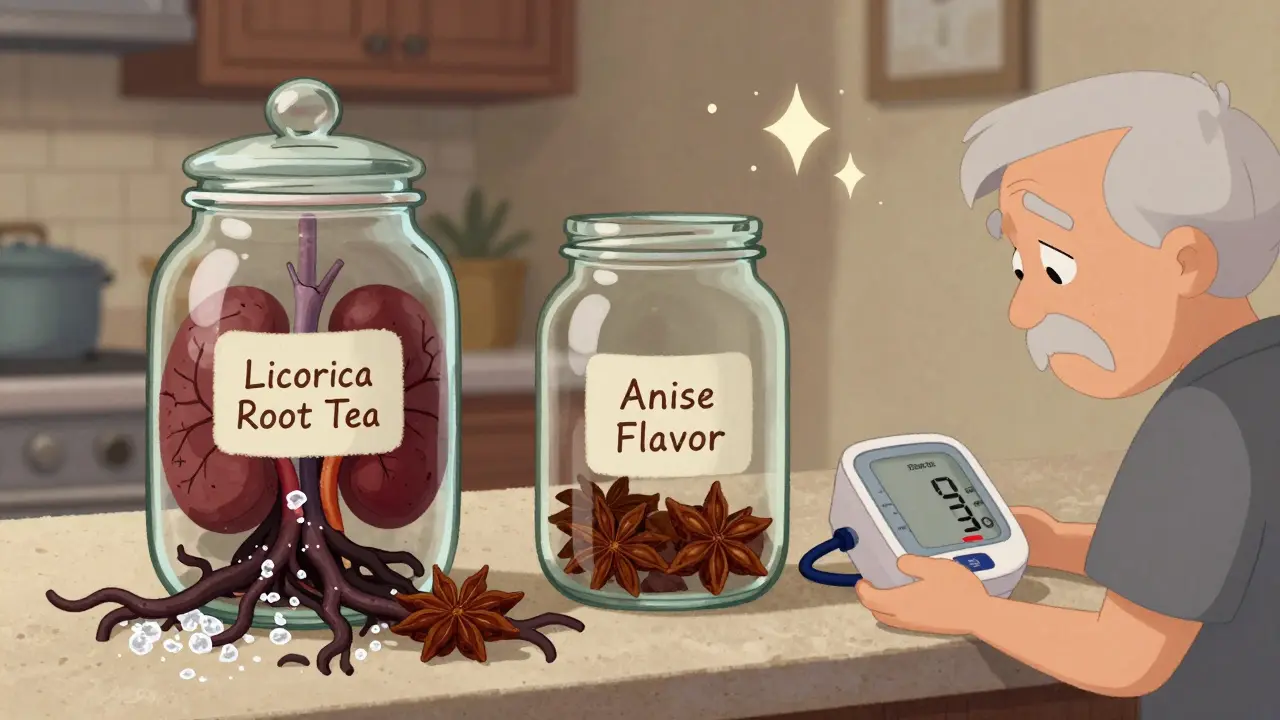
Many people enjoy licorice candy or sip licorice tea thinking it’s just a sweet, harmless treat. But if you’re taking medication for high blood pressure, that piece of black licorice could be quietly undoing your treatment. The problem isn’t the flavor-it’s glycyrrhizin, the active compound in real licorice root. This substance doesn’t just add sweetness; it interferes with how your body handles salt, water, and potassium, directly clashing with the drugs designed to lower your blood pressure.
How Licorice Attacks Your Blood Pressure Control
Glycyrrhizin breaks down in your gut into glycyrrhetic acid, which blocks an enzyme in your kidneys called 11β-HSD2. Normally, this enzyme keeps cortisol-the stress hormone-from acting like aldosterone, a hormone that tells your body to hold onto salt and water and flush out potassium. When 11β-HSD2 is shut down, cortisol takes over. Your kidneys start behaving as if you’re flooded with aldosterone: sodium builds up, water follows, and potassium drains away.
This isn’t theoretical. Studies show that people who regularly consume more than 100 mg of glycyrrhizin a day-roughly 60 to 70 grams of traditional black licorice candy-see their systolic blood pressure rise by an average of 5.5 mmHg. That might not sound like much, but for someone already struggling to keep their blood pressure under control, it’s enough to push them into dangerous territory. Add in low potassium levels, which drop by 0.5 to 1.0 mmol/L in chronic users, and you’ve created the perfect storm for heart rhythm problems and muscle weakness.
Which Blood Pressure Medications Are Most Affected?
Licorice doesn’t play favorites-it undermines nearly every class of blood pressure medication. But some interactions are especially dangerous.
- Diuretics (like hydrochlorothiazide or furosemide): These drugs help lower blood pressure by flushing out extra fluid. But they also make you lose potassium. Licorice does the same thing. Together, they can crash your potassium levels so low that your muscles go limp or your heart starts beating erratically.
- ACE inhibitors (like lisinopril or captopril): These drugs relax blood vessels and reduce fluid buildup. Licorice does the opposite-it adds fluid. The result? Your medication stops working, and your blood pressure climbs.
- Calcium channel blockers (like amlodipine or nifedipine): While these aren’t directly affected by the same enzyme, the extra fluid volume from licorice makes them less effective at lowering pressure.
- Digoxin (Lanoxin): This one is life-threatening. Low potassium from licorice lets digoxin bind too tightly to heart cells. That can cause nausea, confusion, visual disturbances, and even fatal heart rhythms. There are documented cases of older adults ending up in the hospital with heart failure after taking herbal laxatives that contained licorice.
- Potassium-sparing diuretics (like spironolactone or eplerenone): These are meant to keep potassium up. But licorice forces it out anyway. You’re essentially fighting yourself.
It doesn’t matter if you take your meds exactly as prescribed. If you’re eating licorice daily, your treatment is compromised.
What Counts as ‘Licorice’? Not All of It Is the Same
Not every candy labeled ‘licorice’ contains glycyrrhizin. In fact, most modern black licorice candies in North America and Europe are flavored with anise oil and contain no real licorice root at all. The problem is, you can’t tell by looking. A red licorice twist? Probably safe. A dark, chewy stick? Could be loaded with glycyrrhizin.
Real licorice root is found in:
- Traditional black licorice candy (especially imported or artisanal brands)
- Licorice root tea and herbal infusions
- Dietary supplements labeled as ‘licorice root extract’ or ‘Glycyrrhiza glabra’
- Some cough syrups and throat lozenges
- Traditional herbal remedies for digestion or adrenal support
Always check the ingredient list. If it says ‘licorice root,’ ‘glycyrrhizin,’ or ‘Glycyrrhiza glabra,’ you’re at risk. If it just says ‘natural flavoring’ or ‘anise,’ you’re likely safe.
Who’s at the Highest Risk?
Not everyone reacts the same way. Some people can eat a small piece of licorice once in a while with no issues. But certain groups are far more vulnerable:
- People over 60: Aging kidneys are less able to handle the extra salt load.
- Women: Studies show women are more sensitive to glycyrrhizin’s effects, possibly due to hormonal differences.
- Those with existing high blood pressure: Your body is already working hard to keep pressure down. Licorice adds resistance.
- People with heart failure or kidney disease: Your fluid balance is already fragile. Adding salt and water can trigger sudden worsening.
- Anyone taking digoxin: Even small amounts of licorice can tip you into toxicity.
If you fall into one of these categories, the safest move is to avoid licorice entirely.
Signs You Might Be Having a Reaction
Many people don’t realize they’re reacting to licorice until symptoms become severe. Watch for:
- Unexplained rise in blood pressure, even while taking meds
- Muscle weakness, cramps, or a feeling of heaviness in limbs
- Fatigue or lethargy that doesn’t go away
- Swelling in ankles or legs (edema)
- Irregular heartbeat, palpitations, or dizziness
- Headaches or blurred vision
These symptoms often appear after just two to four weeks of daily consumption. If you notice any of these, stop eating licorice immediately and get your potassium and blood pressure checked. A simple blood test can reveal if your cortisol-to-cortisone ratio is off-a clear sign that glycyrrhizin is interfering with your body’s hormone balance.

What Should You Do?
If you’re on blood pressure medication:
- Stop eating black licorice candy unless you’re certain it’s glycyrrhizin-free.
- Check supplement labels. Avoid anything with ‘licorice root’ or ‘Glycyrrhiza glabra.’
- Ask your pharmacist if any of your current supplements contain licorice.
- Monitor your blood pressure at home. If it starts rising without explanation, consider licorice as a possible cause.
- Get a blood test if you’re feeling weak or your BP won’t budge. Low potassium is a red flag.
There’s no need to panic if you’ve had licorice once or twice. But if you’ve been eating it daily-even just a few pieces a week-it’s time to cut it out. Your blood pressure meds will work better without it.
What About Licorice for Health Benefits?
You might have heard licorice is good for digestion, sore throats, or adrenal fatigue. Some studies suggest glycyrrhizin has anti-inflammatory properties. But the risks far outweigh the benefits-especially if you’re on blood pressure meds. There are safer alternatives for all of these issues: ginger for digestion, honey and lemon for sore throats, and stress-reduction techniques for adrenal support. Don’t trade your heart health for a myth.
Even ‘deglycyrrhizinated licorice’ (DGL), sold as a supplement for ulcers, removes glycyrrhizin intentionally. If you want licorice flavor without the risk, choose DGL products-but only after confirming they’re truly glycyrrhizin-free.
The Bottom Line
Licorice isn’t just a sweet snack. For people on blood pressure medication, it’s a hidden threat. It doesn’t just reduce your meds’ effectiveness-it can make you sicker. The science is clear: over 100 mg of glycyrrhizin per day causes measurable harm. Many people don’t realize they’re consuming it daily through candy, tea, or supplements.
If you’re taking medication for high blood pressure, the safest choice is to avoid real licorice completely. Read labels. Ask questions. Don’t assume a candy is safe just because it’s labeled ‘licorice.’ And if you’ve been eating it regularly and your blood pressure won’t go down, stop-and get checked. Your heart will thank you.

Gary Mitts
February 2, 2026 AT 19:46So let me get this straight - I’ve been eating black licorice for years and my BP meds were just pretending to work?
Guess I’ll be switching to gummy bears now. Thanks for the wake-up call.
Akhona Myeki
February 2, 2026 AT 20:27As a South African medical researcher, I must emphasize that this is not merely a Western concern - glycyrrhizin toxicity is underdiagnosed globally, particularly in rural communities where traditional licorice root decoctions are used for ''digestive ailments''. The pharmacokinetics are well-documented in the Journal of Ethnopharmacology, 2018. Ignorance is not bliss - it’s lethal.
Chinmoy Kumar
February 3, 2026 AT 00:23whoa this is wild i never knew licorice could do this
im from india and we use mulethi in chai and ayurveda all the time
maybe i should stop adding it to my tea
thanks for sharing this info man 😊
Brett MacDonald
February 3, 2026 AT 09:17so glycyrrhizin is basically cortisol’s wingman in your kidneys
like a sneaky sidekick that turns your body into a sodium sponge
and we thought we were just eating candy
the universe is a joke
Sandeep Kumar
February 4, 2026 AT 15:45Western medicine overcomplicates everything
in India we’ve used licorice for centuries without modern drugs
if your BP is high because of licorice maybe you need better meds not less candy
stop fearmongering
Bridget Molokomme
February 4, 2026 AT 23:04soooo… my daily licorice tea habit is basically a sabotage mission against my lisinopril?
oh. my. god.
that explains why my BP has been climbing since January.
time to throw out the tea bag stash 🙃
Brittany Marioni
February 5, 2026 AT 12:14Thank you so much for this detailed, life-saving post! 🙏
So many people don’t realize how sneaky herbal supplements can be - especially when they’re marketed as “natural” or “safe.”
Please, if you’re on meds, always check with your pharmacist. And if you’re feeling weirdly tired or your legs are swollen - don’t ignore it. It might be the licorice.
phara don
February 6, 2026 AT 07:51huh. so that’s why my potassium was low last month 😳
guess i’ll be avoiding the black sticks from now on
thanks for the heads up 🤝
Dan Pearson
February 7, 2026 AT 05:24OH MY GOD I JUST REALIZED I’VE BEEN EATING LICORICE EVERY DAY FOR 12 YEARS AND I’M ON AMLODIPINE
MY HEART IS RACING JUST THINKING ABOUT IT
MY DOCTOR IS GOING TO KILL ME
AND I’M TELLING EVERYONE ON FACEBOOK
WE NEED A LICORICE WARNING LABEL
LIKE THE ONES ON CIGARETTES
“THIS MAY CAUSE SUDDEN CARDIAC ARREST IF YOU’RE ON BP MEDS”
Eli Kiseop
February 7, 2026 AT 12:42so if it says anise flavor its fine right
im pretty sure my favorite candy is just anise
but i never checked the ingredients
now im paranoid
larry keenan
February 8, 2026 AT 02:22The inhibition of 11β-HSD2 by glycyrrhetic acid is a well-characterized pharmacodynamic interaction. The resultant pseudohyperaldosteronism leads to sodium retention, potassium wasting, and hypertension - a classic iatrogenic syndrome. The clinical relevance is significant, particularly in polypharmacy populations. I recommend routine screening for glycyrrhizin exposure in patients with refractory hypertension.
Nick Flake
February 9, 2026 AT 16:32Imagine your body is a garden.
Medication is the fertilizer.
Licorice is the invasive weed that chokes everything else out.
And you’ve been watering the weed thinking it’s a flower.
Time to pull it. Gently. But firmly.
And maybe plant some chamomile instead 🌿❤️
Vatsal Srivastava
February 11, 2026 AT 02:05Everyone’s panicking over licorice but no one talks about how sugar in candy raises BP too
so why single out licorice?
you’re all just scared of flavor
also DGL is useless - it’s just flavorless chalk
Monica Slypig
February 12, 2026 AT 17:55my grandma used to give me licorice for coughs
now i realize she was slowly poisoning me
and i thought she was just being sweet
the betrayal is real
and i still have the candy stash
im not touching it
ever
Becky M.
February 14, 2026 AT 07:32as someone who grew up in a household where licorice tea was the go-to for everything - stomachaches, stress, even period cramps - this hit hard.
we didn’t know it was dangerous.
we thought it was healing.
thank you for helping us unlearn what we thought was wisdom.
and yes, i’m throwing out the tea bags. 💛