
Azathioprine and TPMT Testing: How Genetic Screening Prevents Life-Threatening Side Effects

Azathioprine Dosing Calculator
Personalize Your Starting Dose
Based on TPMT enzyme activity and your weight, this tool calculates your safe starting dose of azathioprine.
When you're managing a chronic autoimmune condition like Crohn’s disease or lupus, finding the right medication is only half the battle. The other half? Avoiding a side effect that could land you in the hospital-or worse. That’s where azathioprine and TPMT testing come in. Azathioprine has been used for over 60 years to calm down overactive immune systems. It’s cheap, effective, and works well for long-term maintenance. But for a small group of people, it can cause a dangerous drop in blood cell counts that leads to infections, bleeding, or even death. The good news? We can now predict who’s at risk-before they even take their first pill.
Why Azathioprine Can Be Dangerous
Azathioprine breaks down in your body into active compounds that suppress immune cells. That’s exactly what you want if you have an autoimmune disease. But if your body can’t process it properly, those compounds build up and start attacking your bone marrow. The result? Severe myelosuppression: your white blood cells, red blood cells, and platelets crash. Symptoms include fever, fatigue, bruising, and frequent infections. Left unchecked, it can be fatal.Studies show that 15% to 28% of people on azathioprine experience side effects. Nausea is common, but most people can tolerate it. The real danger lies in the rare, unpredictable reactions. In one study of 139 patients, 10% had to stop the drug because of toxicity. Eleven developed liver damage. One developed severe leukopenia. But here’s the twist: only one of those patients had low TPMT enzyme activity. That means most toxic reactions aren’t caused by genetics alone. Still, for the 0.3% of people with two broken copies of the TPMT gene, the risk is extreme. They can’t break down the drug at all. A standard dose for them is like giving someone a full tank of gas and then lighting a match.
What Is TPMT Testing?
TPMT stands for thiopurine methyltransferase. It’s an enzyme made by your liver that inactivates azathioprine. Your genes determine how much of this enzyme you have. Most people have normal activity. About 10% of the U.S. population has one working copy and one broken copy (heterozygous). These people process the drug slower. And about 0.3% (1 in 300) have two broken copies (homozygous). They have almost no enzyme activity.TPMT testing checks your enzyme level or looks for specific gene variants like *2, *3A, *3B, and *3C. There are two ways to test: genotyping (a blood or saliva DNA test) or phenotyping (measuring enzyme activity in red blood cells). Genotyping is more reliable because it’s not affected by recent blood transfusions or liver disease. Results usually come back in 3 to 7 days. The test costs between $200 and $400 in the U.S., and most private insurers cover it.
How Test Results Change Your Dose
If your TPMT test comes back normal, you start at the standard dose: 1.5 to 2.5 mg per kilogram of body weight per day. That’s about 100 to 150 mg daily for most adults.If you’re heterozygous-meaning you have intermediate enzyme activity-you need a 30% to 70% dose reduction. So instead of 100 mg, you might start at 50 mg. Your doctor will check your complete blood count (CBC) every week for the first month, then every 2 to 4 weeks. If your white blood cell count drops below 3,000, they’ll hold the dose and retest. Many patients never need to go higher than this lower dose and stay stable for years.
If you’re homozygous deficient? Don’t take azathioprine. Period. The risk of life-threatening pancytopenia is too high. Your doctor will switch you to methotrexate, cyclosporine, or a biologic like adalimumab. These are more expensive, but they’re safer for you. The goal isn’t to find the cheapest drug-it’s to find the one that won’t kill you.
What About NUDT15?
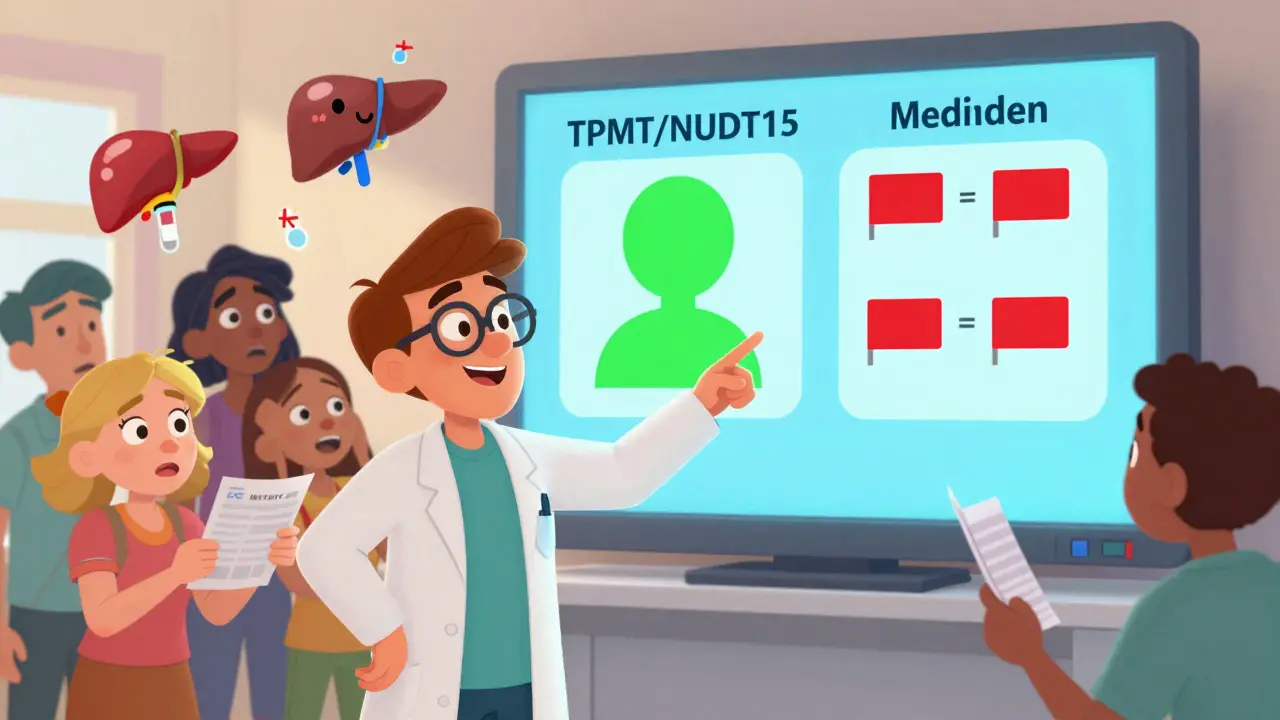
TPMT isn’t the whole story. In Asian populations, up to 20% of people have a different genetic variant called NUDT15 deficiency. This causes the same problem: too much active drug builds up in the bone marrow. A person with normal TPMT but low NUDT15 can still develop severe neutropenia on a standard azathioprine dose.Since 2022, the Clinical Pharmacogenetics Implementation Consortium (CPIC) has recommended testing for both TPMT and NUDT15 together. In Canada and the U.S., labs now offer combined panels. If you’re of East Asian, Southeast Asian, or Hispanic descent, this test is even more important. One study found that NUDT15 variants caused more toxicity than TPMT variants in Korean patients with IBD. Ignoring NUDT15 means missing half the picture.
Testing Isn’t a Silver Bullet
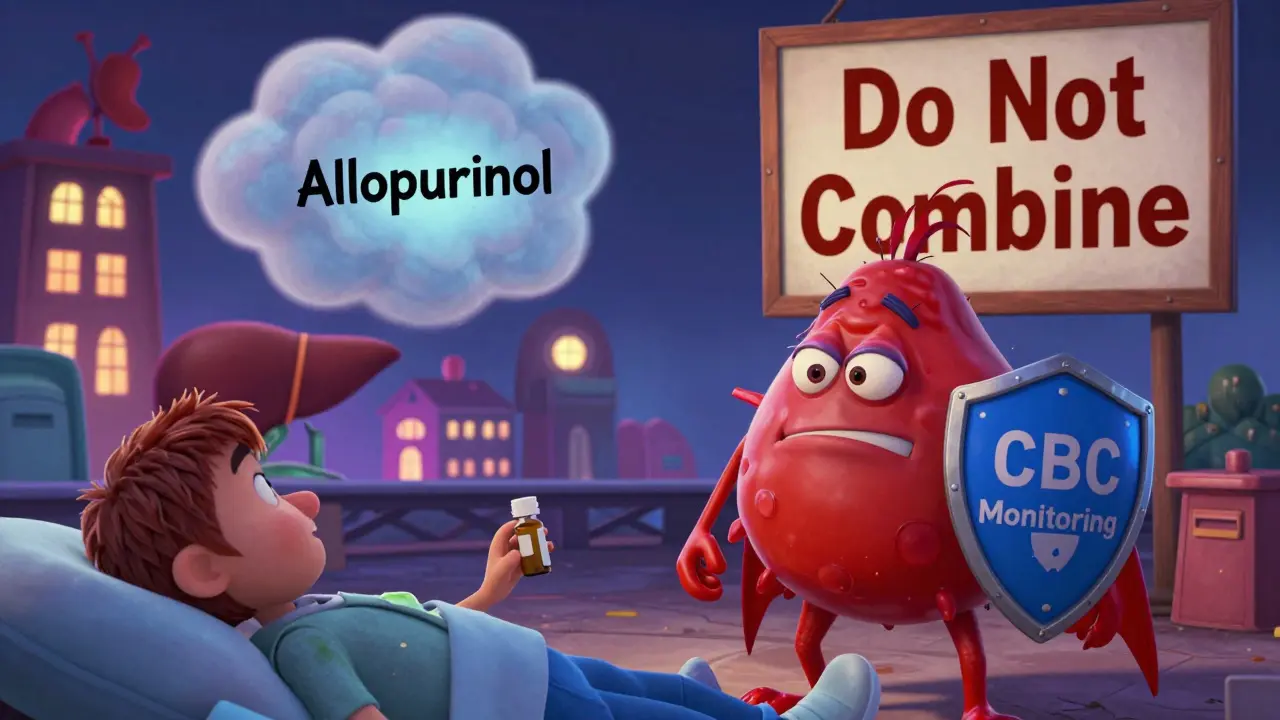
Here’s the hard truth: TPMT and NUDT15 testing don’t prevent all side effects. In a major 2011 trial of 333 patients, researchers found that genotyping didn’t reduce the overall rate of adverse reactions. The group that got tested had 29% side effects. The group that didn’t had 28%. That’s not statistically different.Why? Because other factors matter too. Allopurinol-a drug used for gout-blocks the same enzyme pathway as TPMT. If you’re taking both, your azathioprine levels spike, even if your genes are normal. The same goes for ACE inhibitors, sulfasalazine, and certain antibiotics. Liver disease, kidney problems, and other genetic quirks also play a role. One patient I read about had normal TPMT and NUDT15, but still developed severe liver damage. Another developed pancreatitis. No genetic test predicted that.
That’s why the American Gastroenterological Association (AGA) and ECCO guidelines say: test, yes-but also monitor. You still need a CBC every week for the first month, then every 1 to 3 months. You still need liver function tests. You still need to tell your doctor about every new medication you start. TPMT testing tells you about your genes. It doesn’t tell you about your diet, your other drugs, or your liver health.
Who Should Get Tested?
You don’t need testing if you’re taking azathioprine for one dose, like after a transplant. But if you’re starting it for a long-term condition-IBD, lupus, rheumatoid arthritis, or autoimmune hepatitis-you should be tested. Especially if:- You’re of East Asian, Southeast Asian, or Hispanic heritage
- You’ve had unexplained low blood counts before
- You’re taking allopurinol or other interacting drugs
- You’re planning to stay on azathioprine for more than 6 months
Some clinics test everyone. Others test only high-risk groups. In Europe, 80% of IBD centers test routinely. In U.S. community clinics, it’s closer to 30%. The debate isn’t about whether testing works-it’s about whether it’s worth it for everyone. For the 0.3% of people who would have a catastrophic reaction, it’s life-saving. For the rest, it’s a tool to fine-tune dosing, not a guarantee.
What If You’re Already on Azathioprine?
If you’ve been taking azathioprine for months or years without issues, you probably don’t need testing. But if you’ve had unexplained drops in blood counts, liver enzyme spikes, or had to stop the drug before, get tested. You might find out your body handles the drug differently than you thought.Also, if you’ve had a blood transfusion in the last 3 months, don’t get phenotyping. The transfused red blood cells will give you a false normal result. Wait 60 days or go straight to genotyping.
The Bottom Line
Azathioprine is a powerful, affordable tool for managing chronic immune diseases. But it’s not a one-size-fits-all drug. Your genes matter. Your other medications matter. Your blood counts matter. The best approach? Test before you start. Start low if you’re at risk. Monitor closely. Don’t assume normal results mean zero risk. And never stop checking your CBC just because your TPMT test was clean.Pharmacogenomics isn’t magic. But when it works-when it catches that one person who would have lost their life to a routine dose-it changes everything. For many, it’s not about avoiding side effects. It’s about avoiding death.
Is TPMT testing required before taking azathioprine?
No, it’s not legally required, but major medical organizations like the American Gastroenterological Association and the Clinical Pharmacogenetics Implementation Consortium strongly recommend it. Many insurance companies cover it, and most academic medical centers do it routinely. Skipping the test means you’re relying on luck rather than science to avoid a life-threatening reaction.
Can I take azathioprine if my TPMT test shows low activity?
If you have intermediate (heterozygous) TPMT activity, yes-but at a reduced dose (30% to 70% lower). If you have severe (homozygous) deficiency, you should avoid azathioprine entirely. The risk of life-threatening bone marrow suppression is too high. Your doctor will switch you to a safer alternative like methotrexate or a biologic.
Does NUDT15 testing replace TPMT testing?
No. NUDT15 and TPMT test for different genetic risks. In people of European descent, TPMT variants cause most of the toxicity. In people of Asian descent, NUDT15 variants are more common. For the most complete safety profile, testing for both is now recommended. Some labs offer a single test that checks both genes.
How often should I get blood tests while on azathioprine?
You need a complete blood count (CBC) and liver function tests every week for the first month. After that, every 2 to 4 weeks for the next 3 months. Once you’re stable, you can space them out to every 3 months. Even if your TPMT test was normal, you still need these checks. Toxicity can develop at any time, and it’s often silent until it’s too late.
Can I take azathioprine with allopurinol?
No. Allopurinol blocks the same enzyme that breaks down azathioprine. Even if your TPMT and NUDT15 are normal, this combination can cause dangerous drug buildup and severe toxicity. If you need both drugs, your doctor may switch you to febuxostat (a different gout medication) or use a much lower azathioprine dose with extremely close monitoring. Never combine them without explicit medical guidance.



Sophia Nelson
February 14, 2026 AT 08:39Ugh I hate when doctors act like genetic testing is some magic shield. I’ve been on azathioprine for 5 years, TPMT normal, and still got liver toxicity outta nowhere. They act like you’re dumb if you don’t get tested but then ignore all the other factors. It’s not just genes - it’s your gut, your meds, your stress, your sleep. Stop treating patients like lab rats.
Alyssa Williams
February 14, 2026 AT 23:57Just got my TPMT results back and was heterozygous 😅 turned my dose down to 50mg and feel 100x better. No more nausea, no more brain fog. Seriously y’all if you’re on this med and still feeling like crap - get tested. It’s not expensive, it’s not scary, it’s just smart.
Ernie Simsek
February 15, 2026 AT 21:55LMAO the part where they say 'don't take azathioprine with allopurinol' like it's some groundbreaking revelation 😂 I’ve been on both for 3 years and my WBC dropped to 1.2. Docs were like 'weird!' No it's not weird it's basic pharmacology. Also why is NUDT15 only a footnote? If you're Asian you're basically playing Russian roulette without this test. Stop gaslighting us.
Carla McKinney
February 16, 2026 AT 03:51The fact that this article even suggests TPMT testing is optional is irresponsible. We're talking about a drug that can kill you in weeks. If you're not testing, you're not practicing medicine - you're gambling. And don't get me started on the 30% of U.S. clinics that skip it. This isn't 'personal choice' - it's negligence wrapped in a white coat.
Jonathan Noe
February 17, 2026 AT 05:38As someone who’s been in IBD for 12 years, I’ve seen this play out 3 times. My cousin died from azathioprine toxicity because they skipped the test. My friend had to go on biologics at 22 because her liver crashed. I got tested, went low-dose, and I’m still here. This isn’t theoretical - it’s life or death. And if your doc won’t order the test? Find a new one. Period.
Pat Mun
February 19, 2026 AT 02:02I really appreciate how thorough this is. I’m a nurse who’s seen too many patients get slammed by side effects because everyone assumes 'it’s just nausea' or 'they’re not compliant.' The reality is, some people just metabolize drugs differently - and it’s not their fault. Testing doesn’t just protect lives - it protects dignity. It says: we see you, we believe you, and we’re not going to guess anymore. Also, the NUDT15 point? HUGE. If you’re from Southeast Asia and your doc hasn’t mentioned this - ask for it. It’s not extra, it’s essential.
steve sunio
February 20, 2026 AT 11:21lol why are we even doing this? in nigeria we just give the drug and hope. if u die u die. if u live u live. genetic testing? nah. we got bigger problems like no electricity and no labs. stop making this about your rich america problems.
Robert Petersen
February 21, 2026 AT 14:41Just want to say thank you to whoever wrote this. I was terrified to start azathioprine after reading horror stories - but this gave me real info, not fear. I got tested, had intermediate TPMT, started at 60mg, and now I’m hiking again. It’s not perfect, but it’s possible. Don’t let fear stop you - just be smart about it.
alex clo
February 21, 2026 AT 23:02While the clinical utility of TPMT testing is well-established, one must consider the cost-benefit ratio in low-resource settings. The incremental benefit in populations with low prevalence of TPMT*3A alleles may not justify the logistical and financial burden of universal screening. A risk-stratified approach remains prudent.
Joanne Tan
February 23, 2026 AT 20:14my doctor refused to order the test said 'you're young and healthy so you'll be fine' - guess what? 3 months in, my platelets hit 80k. i went to another doc, got tested, turned out i was heterozygous. they cut my dose and now i'm fine. don't let anyone gaslight you out of your safety. always ask for the test. always.
Ojus Save
February 25, 2026 AT 11:46i am from india and we dont have this test here. my cousin took azathioprine and got sick. no one knew why. now i am on it too. i hope one day we can test here. this is so important.
Annie Joyce
February 27, 2026 AT 05:15Y’all are acting like TPMT is the holy grail - but let’s be real: I had normal TPMT AND normal NUDT15 and still got pancreatitis. My liver enzymes spiked, I was hospitalized. No genetic red flags. So yeah, test - but don’t stop there. Your body isn’t just a DNA printout. It’s a whole ecosystem. Keep monitoring. Listen to your body. If you feel off - speak up. Even if your genes say you’re fine.
Kristin Jarecki
February 28, 2026 AT 23:10It is imperative to underscore that pharmacogenomic testing, while valuable, does not supplant the necessity for vigilant clinical monitoring. The American College of Gastroenterology and European Crohn’s and Colitis Organisation both emphasize that biochemical surveillance remains the cornerstone of safe thiopurine therapy. Genetic data informs, but does not replace, clinical judgment.
Autumn Frankart
March 1, 2026 AT 02:22TPMT testing? Nah. That’s just the government’s way of tracking your DNA so they can deny you insurance later. And don’t get me started on NUDT15 - that’s Big Pharma’s way of making you pay $400 for a test they already know the results of. They’re just trying to sell you biologics. I’ve been on azathioprine for 8 years. I’m fine. Why change what ain’t broke? 🤷♀️