
Probiotics and Gut Health: What the Science Really Says About Digestive Supplements

When you hear the word probiotics, you might think of yogurt ads or a shelf full of pills at the grocery store. But here’s the real question: do they actually help your gut? Or is it just marketing hype? The truth isn’t simple. Some people swear by them. Others take them for months and feel nothing. The science? It’s mixed-but not because probiotics don’t work. It’s because they don’t all work the same way.
What Probiotics Actually Are (And What They’re Not)
Probiotics aren’t magic pills. They’re live bacteria and yeasts that, when taken in the right amount, can help balance your gut microbiome. That’s the trillions of tiny organisms living in your intestines-some good, some neutral, some harmful. Your gut isn’t empty space. It’s a complex ecosystem, and probiotics are meant to support it.
The definition isn’t loose. The International Scientific Association for Probiotics and Prebiotics (ISAPP) says probiotics must be live, given in adequate amounts, and proven to help. That’s key. Not every bacteria in a supplement qualifies. If it doesn’t have research backing its effect, it’s just bacteria in a capsule.
And here’s something most people miss: not all probiotics are the same. Lactobacillus rhamnosus GG is not the same as Lactobacillus acidophilus, even though they’re both Lactobacillus. Each strain has its own job. One might help with diarrhea. Another might reduce bloating. Some do nothing at all.
Where the Evidence Is Strongest
If you’re looking for proof that probiotics work, start with two areas: antibiotic-associated diarrhea and infectious diarrhea in kids.
Antibiotics kill bad bacteria-but they also wipe out good ones. That’s why so many people get diarrhea after a course of antibiotics. A 2023 review by the NIH Office of Dietary Supplements looked at 12 studies with nearly 1,500 adults and kids. Those who took probiotics-especially Lactobacillus rhamnosus GG at 10 billion CFU per day-cut their risk of diarrhea from 22% down to 12%. That’s a huge drop.
For kids with acute infectious diarrhea-like from a virus-the data is even clearer. A Cochrane Review of 82 trials with over 12,000 children found probiotics reduced the risk of diarrhea lasting more than 48 hours by 36%. The effect was strongest with LGG and Saccharomyces boulardii. These strains cut the duration of diarrhea by about a day on average.
That’s not a small thing. For parents, it means fewer sick days, less dehydration risk, and fewer trips to the ER. In fact, the FDA granted a Qualified Health Claim to Lactobacillus rhamnosus GG in 2023 specifically for reducing infectious diarrhea in children. That’s rare. It means the government recognizes the evidence.
Where the Evidence Is Weak or Mixed
Now, let’s talk about the areas where probiotics don’t deliver what people hope for.
For irritable bowel syndrome (IBS), the results are all over the place. Some people feel better. Others feel nothing. A 2020 review from the American Gastroenterological Association found no consistent benefit across studies. Why? Because IBS isn’t one condition. It’s a group of symptoms with different causes. One person’s IBS might be linked to bacterial overgrowth. Another’s might be stress-related. Probiotics won’t fix the latter.
Same goes for Crohn’s disease. The same review found no meaningful benefit. But for ulcerative colitis? There’s a small but real effect. Certain strains like E. coli Nissle 1917 and VSL#3 (a multi-strain blend) have shown modest improvement in symptoms and remission rates. But it’s not a replacement for medication. It’s a possible add-on.
And don’t believe the hype about probiotics helping with weight loss or blood sugar. Some early studies show hints-but they’re small, short-term, and not replicated consistently. A 2024 study in Frontiers found certain strains might influence insulin sensitivity, but we’re talking lab results and mice. Human trials? Not there yet.

How to Choose a Probiotic That Actually Works
Most people buy probiotics based on price, brand, or how many CFUs are listed. That’s a mistake.
Here’s what you need to look for:
- Strain name-not just “Lactobacillus.” Look for the full name: Lactobacillus rhamnosus GG, not “L. rhamnosus.”
- CFU count-for diarrhea, you need at least 10 billion CFU per day. For general use, 1-5 billion might be enough.
- Research backing-does the brand cite clinical trials? If it just says “supports gut health,” that’s meaningless. Look for studies matching your condition.
- Third-party verification-USP, NSF, or ConsumerLab seals mean the product was tested for what’s on the label. A 2019 test found 30% of probiotics had fewer live bacteria than claimed.
- Storage-some need refrigeration (like VSL#3). Others, like Saccharomyces boulardii, are shelf-stable. Check the label.
And timing matters. If you’re taking antibiotics, take your probiotic at least two hours apart. Don’t mix them. And keep taking the probiotic for 1-2 weeks after the antibiotics end. That’s when your gut needs the most help.
What You Might Experience-And When to Worry
When you start probiotics, you might feel gassy. Or bloated. Maybe even a little crampy. That’s normal-for the first 3 to 7 days. Your gut is adjusting. Most people say it fades.
But if you’re immunocompromised-say, you’re on chemotherapy, have an organ transplant, or have a serious immune disorder-probiotics can be risky. There are rare case reports of probiotics causing bloodstream infections in these patients. Talk to your doctor before starting anything.
Also, if you’re not seeing any benefit after 6-8 weeks, stop. Probiotics aren’t a long-term maintenance pill unless you have a specific, diagnosed need. They’re tools, not supplements you take forever.
The Bigger Picture: Market, Regulation, and Reality
The global probiotic market hit $50 billion in 2022. North America alone spends $16 billion a year on these products. But regulation? It’s a mess.
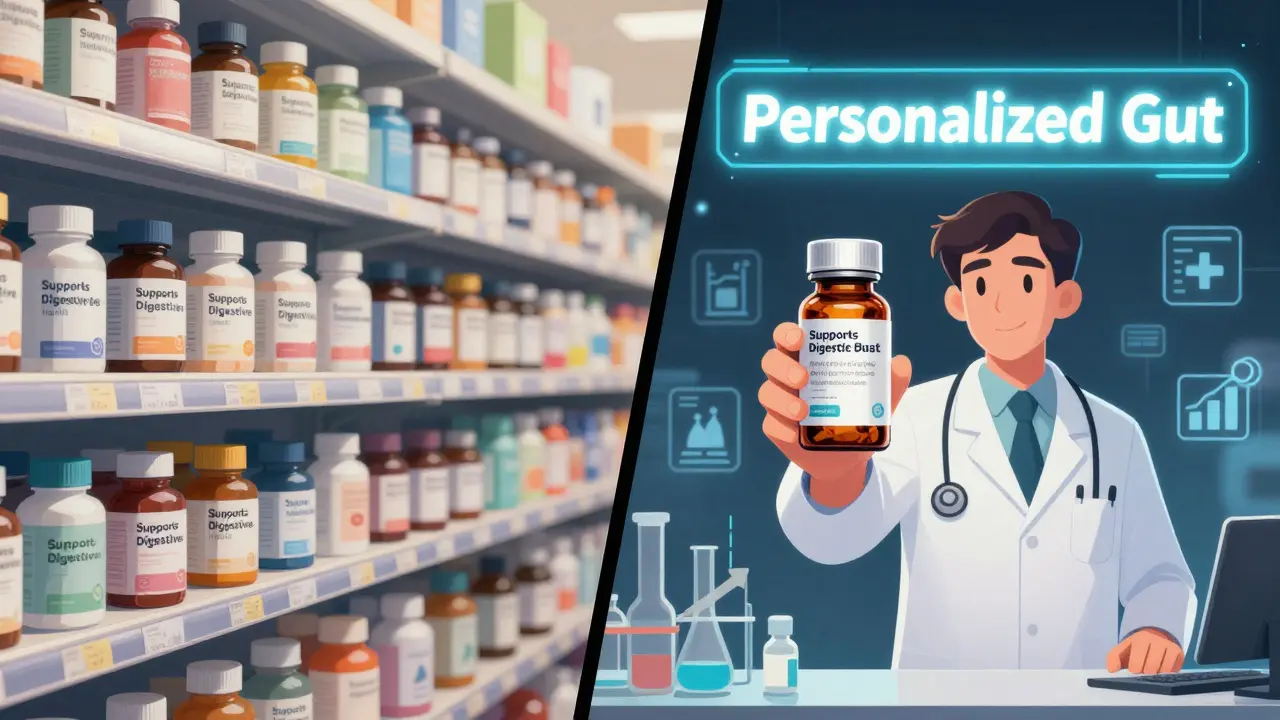
In the U.S., the FDA doesn’t approve probiotics like drugs. They’re sold as dietary supplements. That means companies don’t have to prove they work before selling them. Canada and Italy are stricter-they allow claims like “supports a healthy gut microbiota.” The U.S. doesn’t. That’s why you see vague labels like “supports digestive health.” It’s legal. It’s not helpful.
And here’s the kicker: 74% of users say they feel better. But 26% feel nothing. Why? Because probiotics are personal. Your gut microbiome is unique. What works for your neighbor might do nothing for you. A 2022 study from Mayo Clinic showed that baseline microbiome composition determines whether someone responds to probiotics at all.
That’s why the future is moving toward personalized probiotics. Companies like Viome and Thryve now offer microbiome tests and custom blends. It’s expensive. It’s new. But it’s the only way we’ll move past the one-size-fits-all approach.
Final Take: Probiotics Work-If You Use Them Right
Probiotics aren’t a cure-all. They’re not necessary for everyone. But they’re not useless either.
If you’ve had antibiotic-associated diarrhea, or your child has infectious diarrhea, Lactobacillus rhamnosus GG or Saccharomyces boulardii are backed by strong evidence. Take them at the right dose, at the right time, from a trusted brand.
If you have IBS, ulcerative colitis, or just want to feel better? Try one strain for 6-8 weeks. If nothing changes, move on. Don’t waste money on 50-billion-CFU blends with 12 strains you can’t pronounce.
And if you’re healthy? You probably don’t need them. Your gut is already doing fine.
Probiotics aren’t magic. But when used with clear goals and good science, they can be a real help.
Do probiotics help with bloating and gas?
Some strains can help, but results vary. Lactobacillus plantarum DSM 9843 showed reduced bloating in IBS patients in a 2013 study. But other strains have no effect. If bloating is your main issue, try one strain for 4-6 weeks. If you don’t notice a difference, stop. Also, initial bloating is common in the first week as your gut adjusts.
Can I get probiotics from food instead of supplements?
Yes. Yogurt, kefir, sauerkraut, kimchi, miso, and kombucha contain live cultures. But most don’t list the strain or CFU count, so you can’t be sure you’re getting enough of the right bacteria. For targeted benefits-like preventing antibiotic diarrhea-supplements with proven strains are more reliable.
Are probiotics safe for kids?
Yes, for healthy children. Lactobacillus rhamnosus GG and Saccharomyces boulardii are well-studied in kids and recommended for infectious diarrhea and antibiotic-associated diarrhea. Doses should be age-appropriate. Always check with a pediatrician if your child has a weakened immune system or chronic illness.
How long does it take for probiotics to work?
For acute issues like diarrhea, you might see improvement in 2-3 days. For chronic conditions like IBS or general gut balance, it can take 2-8 weeks. Don’t give up after a week. But if there’s no change after 8 weeks, it’s unlikely to help.
Should I take probiotics every day?
Only if you have a specific reason. If you’re taking them for antibiotic recovery, stop after 1-2 weeks. If you have ulcerative colitis and your doctor recommends them, keep going. But if you’re healthy and just want to “boost your gut,” daily use isn’t proven to help-and may not be necessary. Your gut doesn’t need constant outside help.
What’s the best probiotic brand?
There’s no single “best.” Look for brands with third-party testing (USP, NSF, ConsumerLab), clearly listed strains, and research backing the specific use you need. Culturelle (LGG) has strong evidence for diarrhea. VSL#3 is used for ulcerative colitis. Garden of Life and Renew Life are popular, but check their strain data. Avoid brands that only list “100 billion CFU” without naming strains.



Ben Kono
January 10, 2026 AT 14:46Probiotics are a scam unless you’re on antibiotics
Cassie Widders
January 11, 2026 AT 06:02I tried them after antibiotics and honestly felt nothing. Just spent $30 on yogurt pills.
Faith Wright
January 12, 2026 AT 06:08That’s because you picked the wrong strain. If you don’t know LGG from a random blend, you’re just throwing money at the gut.
Cecelia Alta
January 14, 2026 AT 02:07OMG YES. I bought that 50-billion-CFU thing with 17 strains and felt like a balloon. Then I switched to Culturelle and boom - no more bloating. Also I’m never buying another probiotic without checking the strain. The label lies.
Rinky Tandon
January 16, 2026 AT 01:32Let me tell you something about probiotics - they’re not just supplements, they’re a microbiome revolution. The gut-brain axis is the new frontier of neuroimmunology and if you’re not optimizing your dysbiosis with strain-specific, CFU-dosed, third-party-verified bioactives, you’re literally just feeding your colon with placebo. I’ve seen patients with SIBO go from 7/10 pain to 2/10 on L. plantarum DSM 9843 - it’s not anecdotal, it’s epigenetic modulation.
And don’t get me started on kombucha - it’s a sugar bomb with one strain that’s probably dead by the time it hits your shelf. You think you’re being healthy? You’re just fermenting your wallet.
And yes, I’ve done the microbiome test. My baseline was a disaster. Viome told me I needed a custom blend. I spent $300. My gut now sings. I’m not just healthy - I’m biooptimized.
Meanwhile, people are still asking if yogurt counts. Honey, your yogurt has more sugar than your ex’s excuses.
Probiotics aren’t magic. They’re precision medicine. And if you’re not treating your gut like a high-performance engine, you’re driving a Tesla with a lawn mower engine.
Also, if you’re immunocompromised, don’t take them. I’ve seen sepsis cases from Lactobacillus. Don’t be the guy who thinks ‘natural’ means ‘safe’.
And no - they don’t help you lose weight. That’s TikTok pseudoscience. Your fat cells don’t care about Bifidobacterium. Eat less sugar. Move more. Stop blaming your microbiome for your bad habits.
But for antibiotic diarrhea? 10 billion LGG? Absolute gold. I’ve prescribed it for years. It works. Not because it’s trendy - because it’s evidence-based.
So stop buying the stuff with glitter on the bottle. Read the label. Know your strain. Or stay bloated.
jordan shiyangeni
January 16, 2026 AT 21:42It’s infuriating how the FDA allows companies to market probiotics as dietary supplements when they clearly function as therapeutic agents, especially given the robust clinical data supporting strain-specific efficacy for conditions like antibiotic-associated diarrhea and pediatric infectious diarrhea - the fact that these products aren’t regulated like drugs is not just a regulatory failure, it’s a public health liability, because consumers are being misled by vague claims like ‘supports digestive health’ while legitimate, clinically validated strains like Lactobacillus rhamnosus GG and Saccharomyces boulardii are buried under marketing fluff and unverified CFU counts, and let’s not forget the 30% of products that contain significantly fewer viable organisms than advertised - this isn’t just negligence, it’s corporate exploitation of consumer trust under the guise of wellness, and until the FDA enforces labeling transparency and requires pre-market clinical proof for any health claim, we’re just enabling a multi-billion-dollar placebo economy disguised as science.
Audu ikhlas
January 17, 2026 AT 20:06USA probiotics industry is fake. In Nigeria we use natural fermentation - ogiri, iru, garri - these are real probiotics, not pills made in lab with fancy names. You guys buy pills like they’re vitamins but our grandmas knew this 50 years ago. Why you always need to pay for what nature gives free? Your body don’t need your credit card to be healthy.
Sonal Guha
January 19, 2026 AT 07:23Probiotics work only if you have a diagnosed condition like SIBO or post-antibiotic dysbiosis. Otherwise you’re just paying for bacteria that die before they reach your colon. Most supplements are useless. The market is a scam. Stop wasting money.
laura manning
January 20, 2026 AT 18:59It is imperative to note, with respect to the regulatory framework governing probiotic dietary supplements in the United States, that the absence of pre-market approval by the Food and Drug Administration (FDA) constitutes a significant gap in consumer protection. Consequently, the onus falls upon the consumer to perform due diligence in evaluating product claims, verifying third-party certifications (e.g., USP, NSF), and ensuring strain specificity - as the majority of commercially available products lack sufficient evidence to substantiate their purported health benefits. Moreover, the prevalence of misleading labeling and inconsistent viable colony-forming unit (CFU) counts further exacerbates this issue, rendering many probiotic interventions functionally inert.
Jay Powers
January 22, 2026 AT 01:42I think the key is not to see probiotics as a cure but as a tool. Like a wrench - useful if you know what you’re fixing. If you’re not sure, don’t just grab the biggest one. Try one strain. Give it time. If nothing changes, stop. No shame in that.
Lawrence Jung
January 23, 2026 AT 02:26Probiotics are just the latest iteration of the human desire to outsource our biological complexity to a pill. We’ve stopped trusting our own systems, our own ecosystems, and instead, we’ve outsourced balance to corporations selling freeze-dried microbes in plastic bottles. We’ve become afraid of our own guts. The real cure isn’t in a capsule - it’s in fiber, in fermented foods, in sleep, in stress reduction. The microbiome doesn’t need fixing. It needs listening.
beth cordell
January 23, 2026 AT 08:56YOGURT + KIMCHI + KOMBUCHA = 🌱💚 My gut is a garden and I’m the gardener. No pills needed. Also I’m not paying $40 for a capsule that says ‘Lactobacillus sp.’ like it’s a secret agent 🤫
Jose Mecanico
January 24, 2026 AT 17:04I took LGG after my last round of antibiotics. Felt better in 3 days. No more cramps. I’m just saying - it worked for me. I didn’t overthink it.
Abner San Diego
January 24, 2026 AT 18:08Probiotics are for people who don’t want to eat vegetables. You think a pill fixes your junk food gut? Nah. You need kale. You need sleep. You need to stop drinking soda. Stop blaming your microbiome for your bad choices. I’ve seen people spend $500/month on probiotics and still eat pizza three times a week. That’s not science. That’s denial.