
Fixed-dose combination drugs: what they are and why they exist

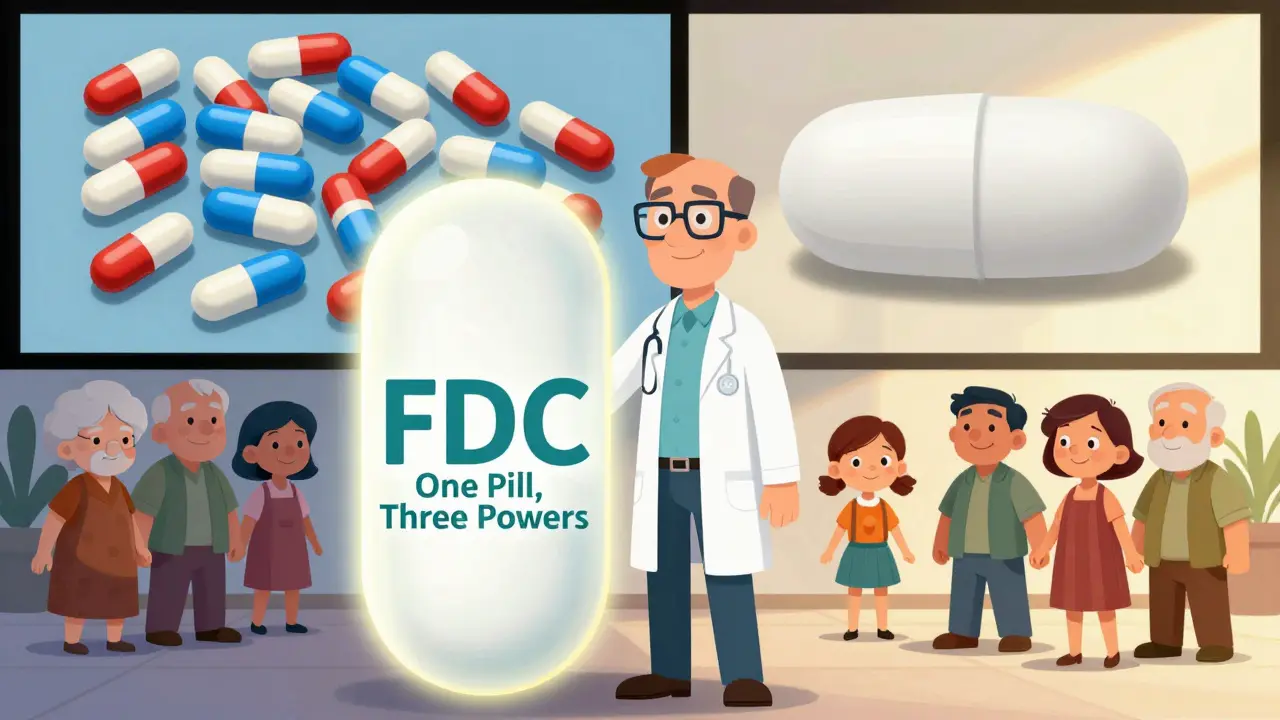
Fixed-dose combination drugs (FDCs) are pills or capsules that pack two or more active medicines into a single dose. You don’t have to choose between separate tablets - it’s all in one. Sounds simple, right? But behind that little pill is a whole story of science, strategy, and patient care. These aren’t just convenience products. They’re designed to solve real problems: too many pills, poor adherence, and sometimes, better outcomes when drugs work together.
How FDCs Actually Work
Think of an FDC like a pre-mixed cocktail of drugs. Each ingredient has a fixed amount - you can’t tweak it. If a pill contains 10 mg of Drug A and 5 mg of Drug B, that’s it. No more, no less. This rigidity is intentional. It’s not a flaw; it’s a design choice based on clinical evidence.
For example, the combination of levodopa and carbidopa is a classic FDC used for Parkinson’s disease. Levodopa helps restore dopamine in the brain, but alone, much of it gets broken down before it reaches the brain. Carbidopa blocks that breakdown. Together, they work better than either drug alone. The ratio? Precisely calibrated. Too much carbidopa? You might get side effects. Too little? The levodopa doesn’t work well. The FDC locks in the sweet spot.
Same goes for HIV treatment. Back in the early 2000s, patients had to take up to 20 pills a day. Today, many take just one FDC tablet that combines three or four antivirals. That’s not magic - it’s pharmacology. Each drug in the combo attacks HIV at a different stage of its life cycle. When they’re taken together, the virus has nowhere to hide.
Why Do FDCs Exist? The Real Reasons
People often assume FDCs are just about making life easier. And yes, that’s part of it. But there’s more.
1. Fewer pills = better adherence
Studies show that when patients have to take four or five pills a day, adherence drops fast. By 30 days, nearly half stop taking at least one of them. But when you combine those into one pill? Adherence jumps by 20-30%. The World Health Organization found this pattern across dozens of chronic conditions - from high blood pressure to tuberculosis. One pill is easier to remember. Less clutter on the counter. Fewer trips to the pharmacy.
2. Synergy matters
Some drugs don’t just add up - they multiply. Take sulfamethoxazole and trimethoprim. Used separately, they fight bacteria. Together, they block two steps in the same bacterial pathway. The result? A 10x stronger effect than either alone. That’s synergy. It’s not just convenience - it’s effectiveness you can’t get any other way.
3. Cost and logistics
One FDC pill often costs less than buying two separate drugs. Why? Fewer manufacturing steps, one packaging line, one prescription to fill. For patients, it means one co-pay instead of two or three. For pharmacies, it means fewer errors when dispensing. For hospitals, it cuts down on inventory tracking.

The Flip Side: When FDCs Don’t Work
Not all FDCs are created equal. And that’s the problem.
Some combinations were never meant to be. Take the example of older FDCs for high blood pressure that paired a diuretic with an old beta-blocker - both were approved decades ago, but no one ever proved they worked better together than apart. These are called “irrational FDCs.” The WHO warns against them. Why? Because if one drug needs a higher dose but the other doesn’t, you’re stuck. You can’t adjust. You might be overdosing one component just to get the right dose of the other.
Another issue? Pharmacokinetics. If one drug is absorbed quickly and the other slowly, taking them together doesn’t help - it might even make things worse. That’s why regulators now require detailed studies on how each drug behaves in the body when combined. The FDA’s 2015 guidelines made this clear: every ingredient must prove it contributes to the benefit.
And then there’s the business side. Some drug companies use FDCs as a way to extend patents. When a popular drug’s patent is about to expire, they slap it together with a generic and file a new patent on the combo. Payers notice. Pharmacists notice. Patients notice. And when that happens, trust erodes.
What’s Regulated - And What’s Not
The FDA and EMA don’t just rubber-stamp FDCs. They require proof. For a combo to get approved:
- Each drug must show it adds real benefit
- The fixed ratio must match what’s clinically effective
- There must be no dangerous interaction between the ingredients
- Pharmacokinetic data must prove absorption and timing are compatible
That’s why 51% of FDCs approved between 2010 and 2015 still needed full Phase 2 and 3 trials - even if one or both ingredients were already on the market. The 505(b)(2) pathway lets companies rely on existing safety data, but it doesn’t skip the hard part: proving the combo works better than the parts alone.
The WHO’s criteria are even stricter. For a combination to be considered “rational,” it must:
- Use drugs with different mechanisms
- Have similar absorption times
- Avoid adding toxic side effects
- Be clearly better than separate dosing
That’s why only 18 FDCs made the WHO’s 2005 Essential Drugs List - and why, by 2023, that number had grown to over 30. Only the ones that truly helped patients made the cut.
Where FDCs Shine - And Where They’re Headed
Cardiovascular drugs lead the pack. Think of pills that combine an ACE inhibitor, a diuretic, and a calcium blocker. These are common because high blood pressure rarely responds to just one drug. FDCs here aren’t just convenient - they’re standard care.
Dermatology is another big area. Acne treatments often combine antibiotics, retinoids, and benzoyl peroxide. One cream replaces three. Patients use it longer. Results improve.
But the future? Oncology. Neurodegenerative diseases. Antimicrobial resistance.
In cancer, FDCs are being tested to hit multiple pathways at once - stopping tumor growth while blocking its escape routes. In Alzheimer’s, combinations targeting both amyloid plaques and inflammation are in trials. And in the fight against superbugs, new FDCs like beta-lactam/beta-lactamase inhibitor combos are proving critical. These aren’t just pills - they’re last-resort weapons.
What’s changing? The bar is rising. Payers now demand real-world evidence: Did hospital visits drop? Did patients stay on treatment longer? Did outcomes improve? Convenience alone won’t cut it anymore.
What Patients Should Know
If your doctor prescribes an FDC, ask: “Why this combo?”
- Is it proven to work better than separate drugs?
- Can I adjust doses if my needs change?
- Is this a new innovation - or just a patent extension?
Don’t assume all FDCs are equal. Some are life-changing. Others are just rebranded versions of old drugs. The best ones? They’re backed by solid data, not just marketing.
And if you’re switching from multiple pills to one FDC - give it time. Your body might react differently. Track side effects. Talk to your pharmacist. It’s not just about taking fewer pills. It’s about taking the right ones - together.
Are fixed-dose combination drugs the same as co-packaged drugs?
No. FDCs combine drugs into a single tablet or capsule. Co-packaged drugs are separate pills in one blister pack or box. They’re still taken as individual doses. FDCs simplify dosing; co-packaged drugs simplify packaging. Regulators treat them differently - FDCs require proof of synergy, while co-packaged drugs just need clear labeling.
Can I split an FDC pill if I need a lower dose?
Generally, no. FDCs are designed as fixed ratios. Splitting a pill doesn’t give you half of each drug - it might give you uneven amounts, especially if the tablet isn’t scored. If your dose needs adjustment, talk to your doctor. There may be another FDC available, or switching to separate pills could be safer.
Why do some FDCs cost more than the individual drugs?
Sometimes, they don’t - but when they do, it’s often because the combo is still under patent. Brand-name FDCs can be expensive, especially if they’re designed to extend market exclusivity. Once generics enter, prices usually drop. But even then, some FDCs cost more because of complex manufacturing or proprietary delivery systems. Always compare prices with separate generics.
Are FDCs safe for elderly patients?
They can be - but only if chosen carefully. Older adults often take multiple medications, so FDCs can reduce pill burden. But they’re also more sensitive to side effects. If an FDC includes a drug with narrow therapeutic range (like digoxin or warfarin), the fixed dose might be too high or too low. Always review FDCs with a pharmacist or geriatric specialist.
Do FDCs increase the risk of drug interactions?
Not necessarily - but they can make interactions harder to spot. When you take two separate drugs, it’s easier to tell which one caused a side effect. With an FDC, if you get nausea or dizziness, you don’t know which component triggered it. That’s why doctors need full medication lists and why pharmacists screen for interactions even with combos.




Tom Bolt
March 10, 2026 AT 16:38Let me get this straight: you’re telling me that combining drugs into a single pill is somehow revolutionary? I’ve been taking my blood pressure meds this way for a decade. The fact that this even needs an article is a testament to how poorly informed the public is about basic pharmacology. Fixed-dose combinations aren’t magic-they’re math. And if you can’t grasp that, you probably shouldn’t be reading medical content at all.
Shourya Tanay
March 12, 2026 AT 09:16The pharmacokinetic alignment in FDCs is fascinating-particularly when you consider the enterohepatic cycling dynamics between components like sulfamethoxazole and trimethoprim. The synergy isn’t merely additive; it’s multiplicative due to sequential blockade of the folate pathway. This isn’t just convenience-it’s a paradigm shift in antimicrobial stewardship. The WHO’s criteria for rational FDCs reflect a deep understanding of therapeutic kinetics, not just marketing.
Kenneth Zieden-Weber
March 14, 2026 AT 03:25So let me get this straight-you’re praising FDCs like they’re the second coming of penicillin? Meanwhile, half the combos on the market are just Big Pharma’s way of extending patents. You think I don’t know that ‘new’ HIV combo that came out last year is just a repackaged version of a 2008 formula with a new patent number? We’re being sold snake oil dressed up as science. And you call this ‘patient care’? Please.
Chris Bird
March 15, 2026 AT 12:13One pill good. Ten pills bad. Simple. Why make it hard?
David L. Thomas
March 15, 2026 AT 12:59The real win with FDCs isn’t just adherence-it’s cognitive load reduction. When you’re managing three chronic conditions, the mental bandwidth needed to track dosing schedules, refill dates, and side effect profiles is insane. FDCs don’t just simplify your medicine cabinet-they simplify your life. And in healthcare, sometimes the most profound innovation is the one that doesn’t require you to think so hard just to stay alive.
Randall Walker
March 16, 2026 AT 22:44One pill. One co-pay. One less reason to forget. And yet somehow, we still have people arguing about whether it’s ‘rational’ or ‘marketing.’ Oh, sweet summer child. You think the FDA approves these things because they’re nice? They approve them because the data says: fewer hospitalizations. Fewer ER visits. Fewer deaths. If you’re still stuck on the idea that ‘convenience’ is trivial, you’ve never had to manage a regimen with five different pills and a pill organizer that looks like a chessboard.
Miranda Varn-Harper
March 18, 2026 AT 11:42While I appreciate the clinical rationale presented here, I must point out that the assumption that all patients benefit uniformly from fixed-dose combinations is empirically unsound. Elderly patients with renal impairment, for instance, may require titrations that FDCs inherently preclude. Furthermore, the conflation of adherence metrics with therapeutic efficacy is a statistical fallacy often perpetuated by industry-funded studies. One must question whether improved compliance truly translates to improved outcomes-or merely to increased pharmaceutical revenue.
Alexander Erb
March 18, 2026 AT 20:29Yessssss 😌 One pill = less stress. Less clutter. Less chance of missing a dose. My grandma switched from 7 pills to 2 FDCs and suddenly she wasn’t forgetting meds or taking them at 3 a.m. because she couldn’t read the labels. Also, her pharmacy bill dropped by 40%. I didn’t even know this was a thing until I saw her smile. So yeah. FDCs? Lifesavers. 🙌
Donnie DeMarco
March 19, 2026 AT 14:58Man, I used to take like five different pills every morning-looked like I was running a pharmacy in my kitchen. Then my doc switched me to this one FDC thing and it was like, WHOA. No more pill sorting. No more ‘did I take the blue one or the green one?’ It’s just… chill. Like my meds finally got a group chat and decided to get along. Also, it’s cheaper. I’m not mad. I’m just… vibin’.
LiV Beau
March 20, 2026 AT 01:05Can we talk about how FDCs are quietly revolutionizing global health? In low-resource settings, one pill instead of five means you can actually get medicine to remote villages. No refrigeration needed for multiple components. No complex supply chains. Just one box, one prescription, one chance. I’ve seen field nurses hand out FDCs for TB and hypertension and watch people actually stick to treatment for the first time. It’s not just science-it’s dignity.
Adam Kleinberg
March 21, 2026 AT 00:20They’re telling you FDCs are about patient care but they’re really about patent cliffs. Every time a drug’s patent expires, some pharma exec sits down with a whiteboard and says ‘how can we glue this to another drug and call it new?’ Then they charge triple. And you think regulators are protecting you? They’re just rubber-stamping corporate chess moves. Wake up. The system isn’t broken-it’s designed this way.
Denise Jordan
March 22, 2026 AT 16:45Ugh. Another article about how pills are ‘convenient.’ Newsflash: I don’t care. I hate taking meds. I don’t want a one-pill solution. I want to be left alone. Also, why are we pretending this isn’t just Big Pharma’s way of making us dependent? I’m not buying it.
Gene Forte
March 23, 2026 AT 04:25At its core, the development of fixed-dose combinations reflects a profound evolution in medical philosophy-from treating symptoms to optimizing systems. The human body is not a collection of isolated functions but an integrated network. When we design therapies that mirror this complexity, we move beyond reductionism into holistic care. The FDC is not merely a pharmaceutical innovation-it is an ethical statement: that patient well-being should shape science, not profit.
Bridgette Pulliam
March 24, 2026 AT 21:01My cousin’s a pharmacist in rural Ohio. She says FDCs cut down on dispensing errors by like 70%. One bottle instead of three means less chance of handing someone the wrong combo. And for elderly patients with shaky hands? No more struggling with childproof caps or tiny print. It’s not glamorous-but it saves lives. Quietly. Daily. Without fanfare.
Mike Winter
March 26, 2026 AT 00:23Interesting how we romanticize FDCs as if they’re a modern miracle, yet overlook that many were developed without robust head-to-head comparisons against separate agents. The burden of proof should rest not on the patient to justify adherence, but on the manufacturer to demonstrate superiority-not just equivalence. The WHO’s criteria are admirable, but enforcement remains patchy. We must ask: who benefits when we prioritize convenience over comparative effectiveness?