
Ankylosing Spondylitis: How to Manage Spine Inflammation and Keep Moving
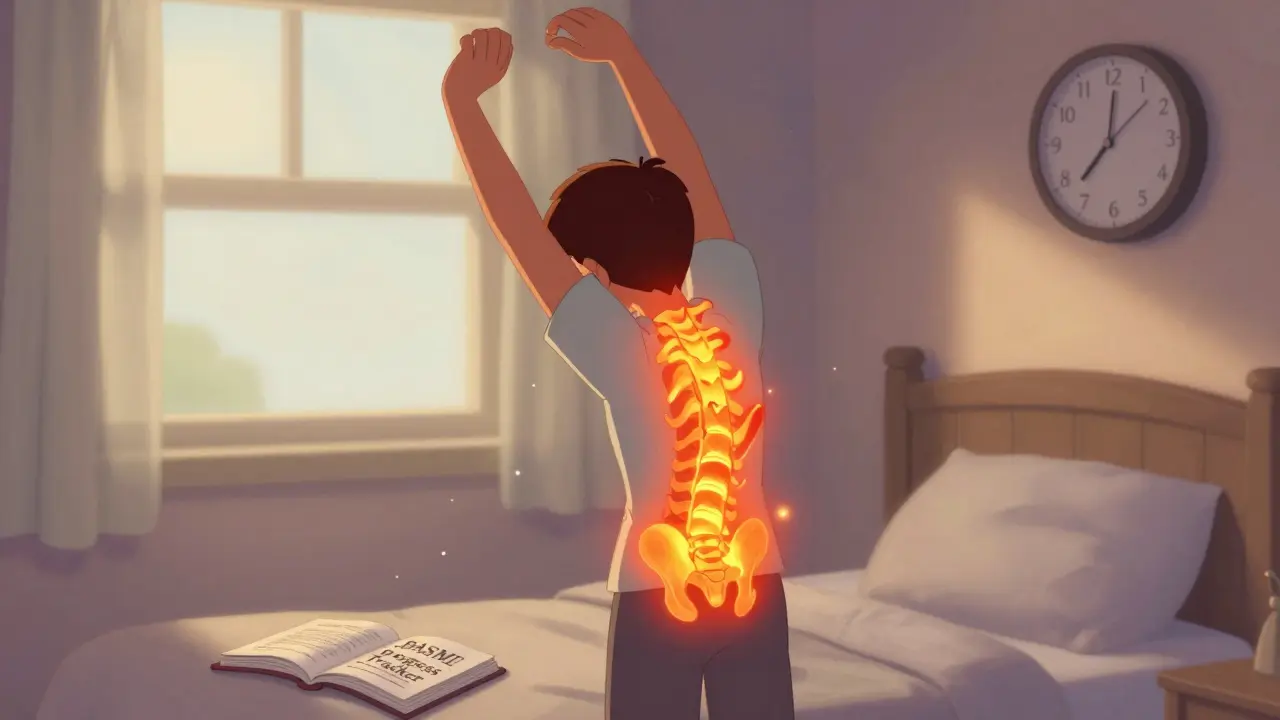
When your back feels stiff every morning and doesn’t loosen up no matter how long you lie there, it’s not just bad posture. When the pain starts before age 45, wakes you up between 3 and 6 a.m., and gets better when you move but worse when you rest - that’s not normal aging. That’s ankylosing spondylitis. It’s not just back pain. It’s your immune system attacking the joints in your spine and pelvis, causing inflammation that can slowly fuse your vertebrae together. Left unchecked, it can turn your spine into a rigid rod. But here’s the truth: you don’t have to lose mobility. With the right approach, most people with AS stay active, work, and live full lives.
What Ankylosing Spondylitis Really Does to Your Spine
Ankylosing spondylitis (AS) is an autoimmune disease that targets the entheses - the spots where tendons and ligaments attach to bone. In the spine, this means the joints between your vertebrae and the sacroiliac joints at the base of your back become inflamed. Over time, your body tries to heal this inflammation by laying down new bone. Instead of fixing the damage, it creates bridges of bone between vertebrae called syndesmophytes. These can eventually fuse your spine into one solid piece - what doctors call a "bamboo spine."
It’s not just your back. About 25-35% of people with AS get acute anterior uveitis - sudden, painful eye inflammation that can damage vision if not treated fast. Up to half may develop inflammatory bowel disease, and 1 in 10 get psoriasis. The disease doesn’t care about your age or fitness level. It hits hardest between 17 and 45, and men are two to three times more likely to be diagnosed than women. But women often have milder symptoms, which means they’re more likely to be misdiagnosed for years.
The biggest red flag? Inflammatory back pain. Unlike mechanical back pain from lifting something wrong, AS pain lasts longer than three months, wakes you up at night, and improves with movement. Morning stiffness lasts more than 30 minutes - sometimes over an hour. You don’t just feel sore. You feel locked.
Why Diagnosis Takes So Long - and How to Speed It Up
Most people wait over three years to get a correct diagnosis. Why? Because many doctors still think back pain is just "bad posture" or "stress." The average patient sees 4.2 doctors before someone recognizes the pattern. If you’ve had chronic back pain since your 20s, especially if it’s worse in the morning and better with exercise, don’t accept "it’s just aging" or "you’re sitting wrong."
There’s no single blood test for AS. But 90% of people with AS test positive for the HLA-B27 gene - though having the gene doesn’t mean you’ll get the disease. About 6% of the general population carries it, but only a small fraction develop AS. The real diagnostic tools are imaging. X-rays show bone changes, but only after years of damage. MRI can spot inflammation in the sacroiliac joints before any bone fusion happens - and that’s critical. If you’re under 45 with inflammatory back pain, ask your doctor for an MRI of your sacroiliac joints. Don’t wait for X-rays to confirm it.
The Two Pillars of Managing AS: Medication and Movement
There’s no cure for AS, but there are ways to stop it from wrecking your spine. The two most powerful tools are medication and movement - and you need both.
Medication: First-line treatment is NSAIDs like naproxen or celecoxib. These aren’t just painkillers. Studies show they can cut radiographic progression by half over two years if taken regularly. If NSAIDs aren’t enough, biologics are the next step. TNF inhibitors like adalimumab or etanercept help 40-60% of patients achieve major symptom relief within 12 weeks. Newer drugs like secukinumab (an IL-17 inhibitor) and upadacitinib (a JAK inhibitor) are showing even better results in reducing bone damage. The 2023 FDA approval of upadacitinib was a big win - it reduced symptoms by 45% in clinical trials compared to 19% for placebo.
But biologics aren’t cheap. Without insurance, they can cost $5,000 to $6,000 a month. Many patients struggle to afford them. Talk to your rheumatologist about patient assistance programs. Some drug companies offer free medication for qualifying low-income patients.
Movement: This is where most people fail - and where the biggest gains are made. Physical therapy isn’t optional. It’s medicine. A structured daily routine of spinal extension, deep breathing, and aquatic exercises can improve spinal mobility by 25-30% in just six months. The Bath Ankylosing Spondylitis Metrology Index (BASMI) measures spine flexibility. People who stick with daily exercise improve their BASMI scores dramatically. Those who skip it? Their spines stiffen faster.

What Mobility Work Actually Looks Like
You don’t need a gym. You need consistency.
- Deep breathing: Lie on your back, place a book on your chest, and breathe in slowly to lift it. This keeps your ribcage flexible - important because AS can fuse the ribs too, making it hard to take full breaths.
- Spinal extension: Lie face down on the floor and gently push your upper body up with your arms. Hold for 10 seconds. Repeat 5 times. This fights the forward curve that AS causes.
- Swimming or water aerobics: Water supports your body, so you can move without pain. One patient on Reddit said swimming 45 minutes daily cut his morning stiffness from 90 minutes to 20 in three months.
- Posture checks: Sit with your back straight, shoulders back. Use a lumbar roll in your chair. Sleep on a firm mattress without a pillow under your head. These small changes reduce pain by 35% in clinical studies.
Start slow. If you’re stiff in the morning, do gentle stretches in bed before getting up. Use a heating pad for 20 minutes before exercising - it loosens stiff joints. Track your progress. Use a free app or journal. People who log their exercises are 78% more likely to stick with them after six months.
What Doesn’t Work - and What Could Hurt You
Rest is not the answer. Sitting for long periods, watching TV, or lying down to "rest" your back makes AS worse. Inactivity accelerates stiffness and fusion.
Yoga can help - but only if done right. Avoid deep forward bends. Focus on back extensions and gentle twists. Look for AS-specific yoga classes. Johns Hopkins offers free online videos designed for AS patients.
Don’t rely on supplements. No pill, powder, or herb has been proven to stop AS progression. Some may help with general inflammation, but they’re no substitute for proven medication or exercise.
And don’t ignore fatigue. It’s not laziness. It’s part of the disease. 74% of AS patients say fatigue is their biggest challenge. That doesn’t mean you can’t move - it means you need to pace yourself. Break exercise into two 15-minute sessions if needed. Do what you can, every day.
Life Beyond the Diagnosis
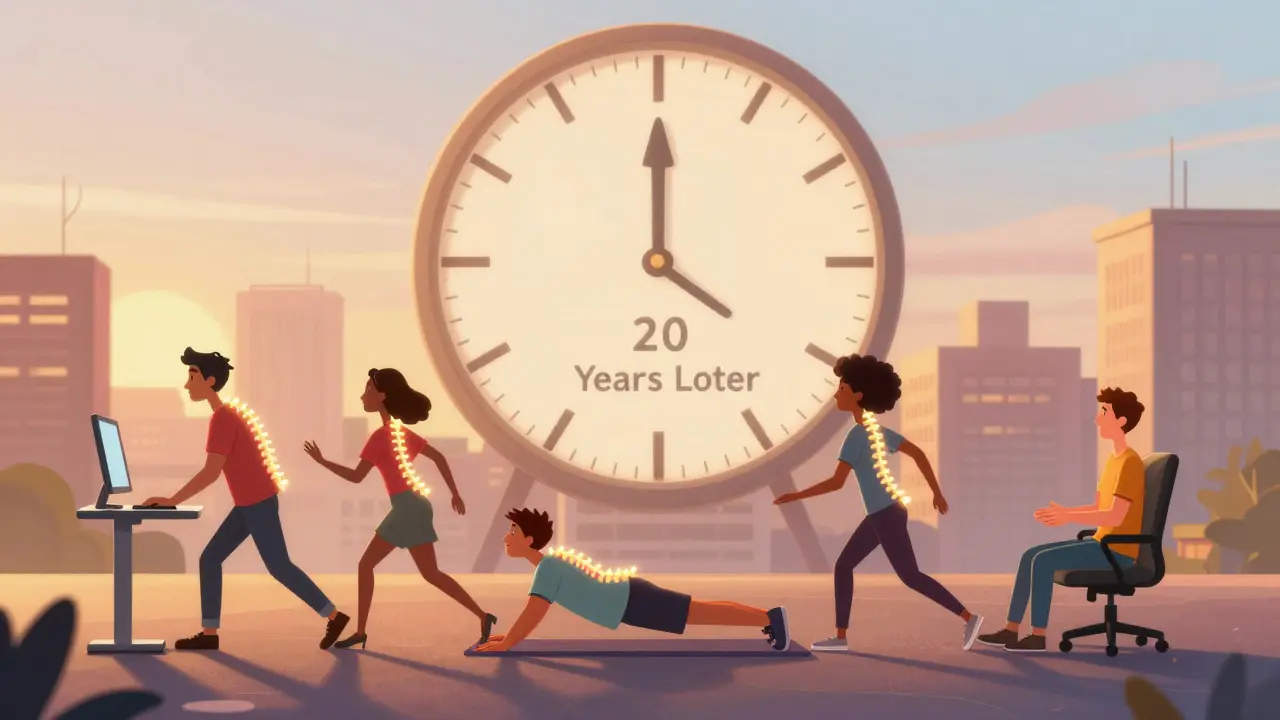
AS changes your life, but it doesn’t have to define it. Most people who manage their disease well maintain independence 20 years after diagnosis. The key is early action. If you’re diagnosed in your 20s or 30s and start medication and exercise right away, you can avoid spinal fusion entirely.
Workplace accommodations help. Standing desks, ergonomic chairs, flexible hours - these aren’t luxuries. They’re necessities. If your job requires long hours sitting, talk to HR. You’re protected under disability laws.
Connect with others. The Spondylitis Association of America has free exercise videos, support groups, and a community of 15,000+ people who get it. You’re not alone. One woman on HealthUnlocked said her customized PT program kept her spine flexible for 15 years - even though she tested positive for HLA-B27. She didn’t beat AS. She learned to live with it - on her terms.
What’s Next for AS Treatment
The future is promising. New drugs like JAK inhibitors are becoming more common. Digital tools - apps that remind you to stretch, track pain, and connect you to virtual PT - are growing fast. The STABILITY trial, now enrolling 500 patients across 35 U.S. centers, is testing whether 150 minutes of moderate exercise per week can prevent spinal fusion better than current guidelines. Early results suggest it can.
Right now, the best thing you can do is act. Get the right tests. Start medication if needed. Move every day. Don’t wait for your spine to fuse. Mobility isn’t a luxury - it’s your lifeline.




Maggie Noe
January 9, 2026 AT 07:15Darren McGuff
January 10, 2026 AT 10:46Ashley Kronenwetter
January 11, 2026 AT 19:01Heather Wilson
January 12, 2026 AT 17:19Jeffrey Hu
January 13, 2026 AT 11:58Matthew Maxwell
January 13, 2026 AT 23:23Kiruthiga Udayakumar
January 14, 2026 AT 04:45Patty Walters
January 15, 2026 AT 23:36Jenci Spradlin
January 16, 2026 AT 13:26Gregory Clayton
January 17, 2026 AT 15:02Catherine Scutt
January 18, 2026 AT 20:37Alicia Hasö
January 19, 2026 AT 16:33Meghan Hammack
January 21, 2026 AT 14:43RAJAT KD
January 23, 2026 AT 08:53