
The Difference Between Medication Side Effects and Adverse Drug Reactions Explained
Medication Symptom Checker
What's Your Symptom?
This tool helps you understand if your symptom is likely a side effect or something else.
When you start a new medication, your doctor might tell you about possible side effects. But what if you get a headache, feel nauseous, or have a rash? Is that a side effect-or something worse? Many people, even some healthcare workers, use these terms interchangeably. But they’re not the same. Understanding the difference can change how you respond to your meds-and even save your life.
What Is a Side Effect?
A side effect is a known, predictable reaction to a drug that happens at normal doses. It’s not a mistake. It’s not an accident. It’s built into how the drug works.
Think of it this way: if a drug targets your brain to help with depression, it might also affect your stomach. That’s not a bug-it’s a feature of the drug’s chemistry. Side effects are identified in clinical trials. Researchers compare people taking the drug to those taking a placebo. If more people in the drug group get a certain symptom-like dry mouth or drowsiness-then it’s labeled a side effect.
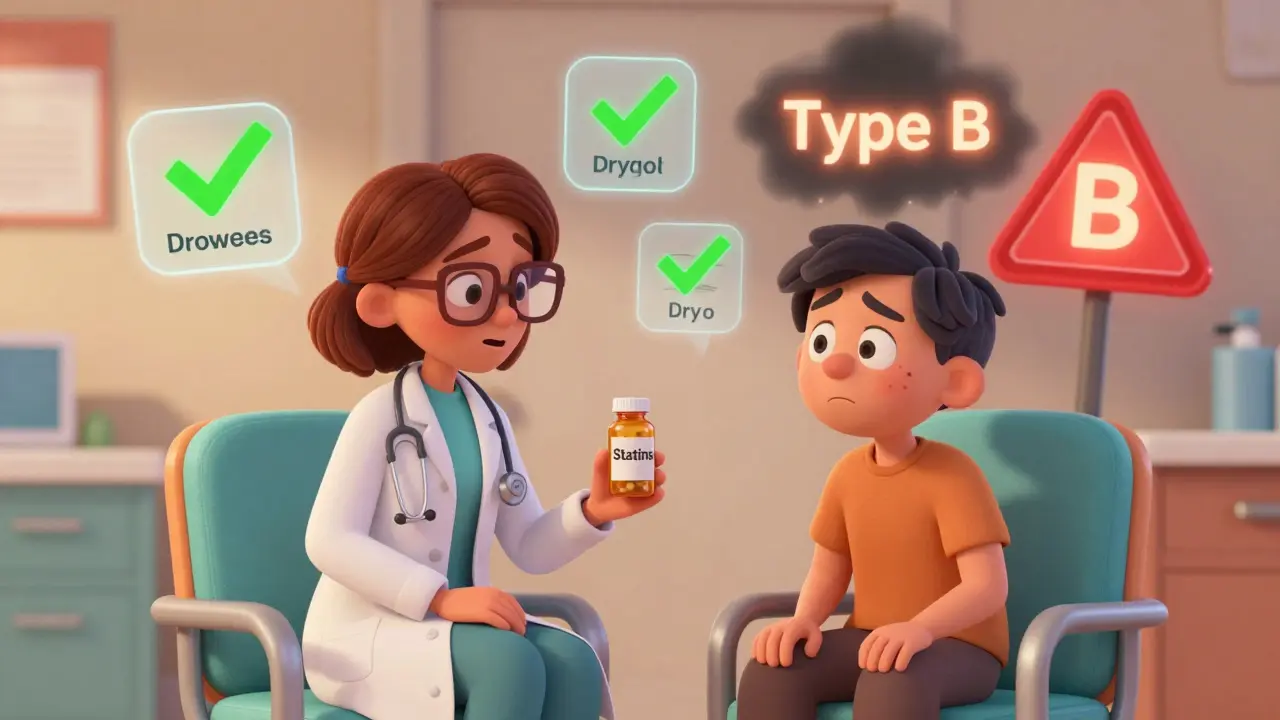
For example, statins used to lower cholesterol often cause muscle aches. That’s a side effect. It’s common, predictable, and directly tied to how the drug works. About 80-85% of all adverse reactions fall into this category. They’re called Type A reactions: dose-dependent, well-understood, and usually not dangerous unless they’re severe or ignored.
What Is an Adverse Drug Reaction?
An adverse drug reaction (ADR) is any harmful, unintended response to a drug taken at normal doses. But here’s the key: an ADR must be caused by the drug. Not just happen around the same time. Not just be something that could’ve happened anyway. It has to be linked.
Let’s say you take a blood thinner and then have a major bleed. If tests and timing confirm the drug caused it, that’s an ADR. But if you take the same drug and get a cold two days later? That’s not an ADR. It’s just bad luck.
ADRs are split into two types:
- Type A (predictable): These are the side effects we just talked about. They’re common, tied to the drug’s action, and often dose-related. Like liver damage from too much acetaminophen.
- Type B (unpredictable): These are rare, strange, and not tied to dose. Think severe allergic reactions or a sudden drop in white blood cells from a drug that normally doesn’t affect your immune system. These are harder to spot in trials because they’re so rare.
Here’s the catch: all side effects are ADRs. But not all ADRs are side effects. Side effects are the predictable kind. Type B reactions? Those are ADRs too-but they’re not called side effects because they’re not expected.
What About Adverse Events?
This is where things get messy. An adverse event is any negative health occurrence that happens after you take a drug-whether it’s caused by the drug or not.
Imagine you’re on a new blood pressure medication. A week later, you fall and break your hip. Was it the drug? Maybe. Maybe you were dizzy. Maybe you just slipped on a wet floor. The event-the fall-is an adverse event. But until you prove the drug caused the dizziness, it’s not an adverse reaction.
Adverse events are the raw data. They’re what patients report. What doctors note. What pharmacies log. But they’re not proof of harm. They’re just clues.
A 2020 study in JAMA looked at a blood thinner called apixaban. Headaches happened in 12.3% of people on the drug and 11.8% on placebo. Same rate. So headaches? Not a side effect. Just coincidence. But major bleeding? 2.1% on the drug, 0.5% on placebo. That’s a side effect. The difference was real. Statistically proven.

Why Does This Matter?
Using these terms wrong isn’t just semantics. It’s dangerous.
A 2021 survey found that 68% of healthcare workers mix up these terms in patient records. That leads to real problems:
- Patients stop life-saving meds because they think a random headache is a side effect.
- Doctors avoid prescribing effective drugs because they think the side effect list is too long-when most symptoms listed are just adverse events.
- Insurance companies deny claims because the documentation says “side effect” when it should say “adverse event.”
One study showed 43% of patients quit their meds after misinterpreting an adverse event as a side effect. That’s not just risky-it’s deadly. Imagine someone stopping their blood thinner because they got a stomach ache. The real danger isn’t the ache. It’s the stroke they could have had.
The FDA now requires drug labels to clearly separate adverse events (everything reported) from adverse reactions (confirmed causes). That’s because confusion costs lives. In 2018, a diabetes drug was pulled in Europe because transient side effects were mistaken for serious reactions. Later analysis showed most weren’t linked.
How Do Experts Tell the Difference?
Hospitals and clinics have systems to sort this out. The University of California San Francisco uses a 3-step method:
- Timing: Did the symptom start after the drug? How long after? Some reactions take days. Others take weeks.
- Dechallenge/rechallenge: If you stop the drug and the symptom goes away, then restart it and it comes back? That’s strong evidence it’s caused by the drug.
- Comparison: Does this reaction match what’s known in drug databases like Micromedex? If it’s listed as a known side effect, it’s likely real.
Top-performing pharmacies get this right 92% of the time. Average ones? Only 67%. The gap isn’t about knowledge. It’s about systems. If your EHR doesn’t let you pick “adverse event” vs. “adverse reaction,” mistakes happen.

What Should You Do?
You don’t need to be a doctor. But you should know this:
- If your doctor says “this drug may cause dizziness,” that’s a side effect. It’s common. It’s expected. Talk to them about managing it.
- If you get a rash, swelling, trouble breathing, or chest pain? That’s not a side effect. That’s an emergency. Call 911. Don’t wait to see if it “goes away.”
- If you feel weird after starting a drug, write it down: what happened, when, and how long it lasted. Bring it to your next appointment.
- Don’t quit a medication because you think you have a side effect. Ask: “Is this confirmed? Or just something that happened while I was on the drug?”
Pharmacists and doctors are trained to spot the difference. But they can’t help if you don’t report accurately. And you can’t make smart choices if you don’t understand the terms.
The Bigger Picture
Technology is helping. New AI tools can now scan patient records and flag patterns that humans miss. In 2023, one AI system improved side effect identification by 41%. The FDA is pushing for real-world data from EHRs to cut the time it takes to confirm a new side effect-from 4 years to under 2.
And it’s not just about drugs. Genetic testing is now showing that some people are far more likely to have certain side effects. For example, if you have a specific gene variant (CYP2C19), you’re nearly 9 times more likely to have bleeding from clopidogrel. That’s not random. That’s personalized medicine.
By 2026, the American Pharmacists Association wants to cut patient confusion about these terms by half. That means clearer labels. Better education. Fewer people stopping meds because they’re scared.
Side effects are part of treatment. But adverse events? They’re noise. Learning to tell them apart isn’t just medical jargon. It’s your right to make informed choices about your health.
Are side effects and adverse reactions the same thing?
No. All side effects are adverse reactions, but not all adverse reactions are side effects. Side effects are predictable, dose-related reactions that show up in clinical trials. Adverse reactions include those plus rare, unpredictable reactions (Type B) that aren’t tied to dose. The term "adverse reaction" is broader.
Can an adverse event become a side effect?
Yes-but only after proof. An adverse event is just an occurrence after taking a drug. If research shows it happens significantly more often in drug users than in placebo users, and it fits the drug’s known action, then it gets labeled a side effect. This process can take years.
What should I do if I experience a new symptom while on medication?
Don’t panic. Don’t stop the drug. Write down the symptom, when it started, how long it lasted, and if anything made it better or worse. Call your doctor or pharmacist. They’ll check if it’s a known side effect, an adverse reaction, or just a coincidence. Most symptoms aren’t caused by the drug.
Why do drug labels list so many side effects if most aren’t serious?
Drug labels list every possible adverse event reported during trials-even if it happened in just one person. This is a legal requirement. But the label doesn’t tell you how common each one is. A headache listed as a side effect might affect 1 in 100 people. A life-threatening reaction might affect 1 in 10,000. Always ask: "How likely is this?"
Can I trust online forums about drug side effects?
Be careful. Online stories are anecdotal. Someone might say, "I took X and got a migraine." But if 10% of people get migraines naturally, and 10% of people taking X also get them, it’s not caused by the drug. Only clinical trials can prove causation. Use forums to feel less alone-not to make medical decisions.
Final Thought
Medication is powerful. It saves lives. But it’s not magic. Every drug has a profile-what it fixes, what it affects, and what risks it carries. Side effects are part of that profile. Adverse events? They’re red flags that need investigation. Learning to tell them apart isn’t about memorizing definitions. It’s about asking better questions. And that’s how you take control of your health.



Dylan Patrick
March 13, 2026 AT 10:25Kathy Leslie
March 13, 2026 AT 16:57Elsa Rodriguez
March 15, 2026 AT 12:42Aaron Leib
March 16, 2026 AT 01:32Amisha Patel
March 17, 2026 AT 03:28Serena Petrie
March 17, 2026 AT 07:09Buddy Nataatmadja
March 19, 2026 AT 03:10mir yasir
March 19, 2026 AT 05:11Stephanie Paluch
March 20, 2026 AT 04:19Lorna Brown
March 20, 2026 AT 12:55tamilan Nadar
March 22, 2026 AT 00:35Adam M
March 23, 2026 AT 08:56Rosemary Chude-Sokei
March 25, 2026 AT 06:16Noluthando Devour Mamabolo
March 26, 2026 AT 19:31Ali Hughey
March 27, 2026 AT 04:33