
Oral Food Challenges: Safety and Diagnostic Value for Allergy Diagnosis
When a child breaks out in hives after eating peanut butter, or an adult gets stomach cramps every time they have milk, it’s easy to assume they have a food allergy. But here’s the problem: most of the time, you’re wrong. Skin prick tests and blood tests for food allergies are convenient, but they’re not reliable. In fact, studies show they give false positives in more than half the cases. That means thousands of people are avoiding foods they don’t actually need to - and living with unnecessary fear, restricted diets, and social isolation. The only way to know for sure? An oral food challenge.
Why Oral Food Challenges Are the Gold Standard
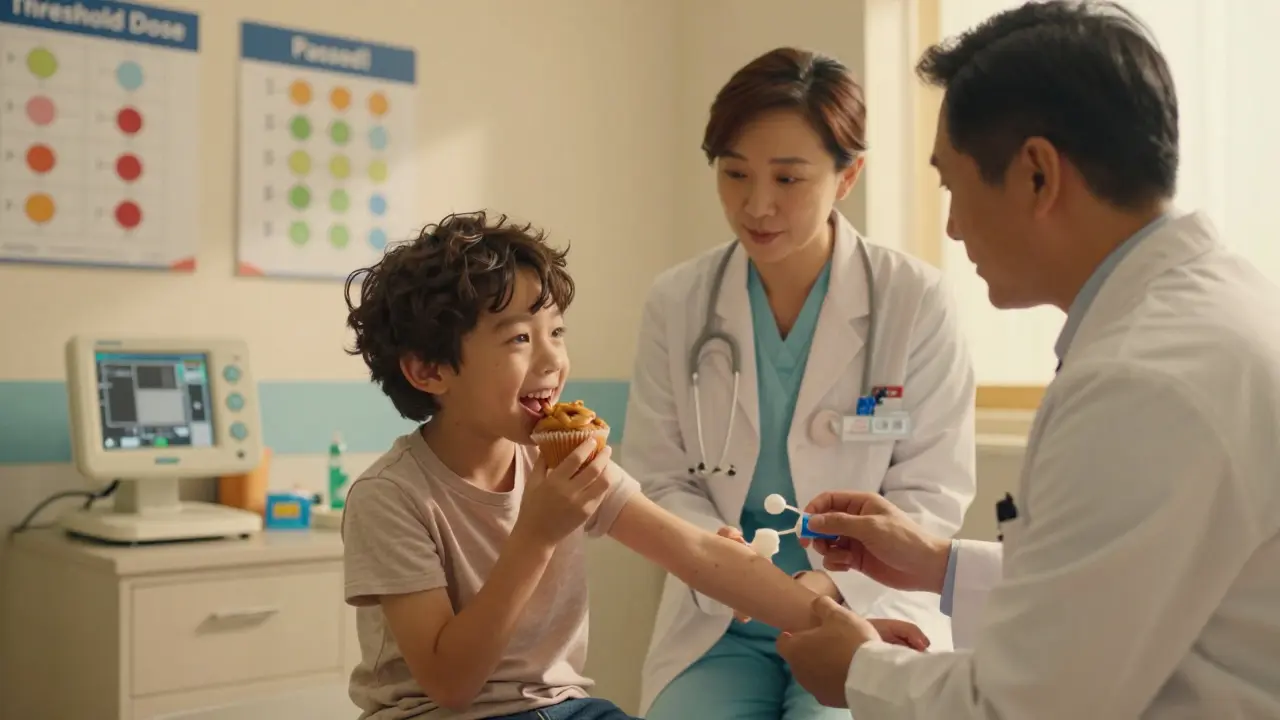
An oral food challenge (OFC) is the only test that can definitively confirm or rule out a food allergy. It’s not a guess. It’s not a lab result. It’s real food, given in small, controlled amounts while doctors watch your body’s response in real time. The American Academy of Allergy, Asthma & Immunology (AAAAI), the European Academy of Allergy and Clinical Immunology (EAACI), and the Italian Society of Pediatric Allergy and Immunology (SIAIP) all agree: if you want to know whether you or your child is truly allergic, an OFC is the only test that gives you a clear answer. This isn’t just theory. Research from the National Institutes of Health (PMC6843825, 2019) shows that clinical history and lab tests alone have less than 50% accuracy in diagnosing food allergies. That’s worse than flipping a coin. Meanwhile, OFCs have near 100% diagnostic certainty when done correctly. They don’t just tell you if you’re allergic - they tell you how much you can eat before a reaction happens. That’s called the threshold dose. For some, it’s a crumb. For others, it’s a whole serving. That detail changes everything.How an Oral Food Challenge Works
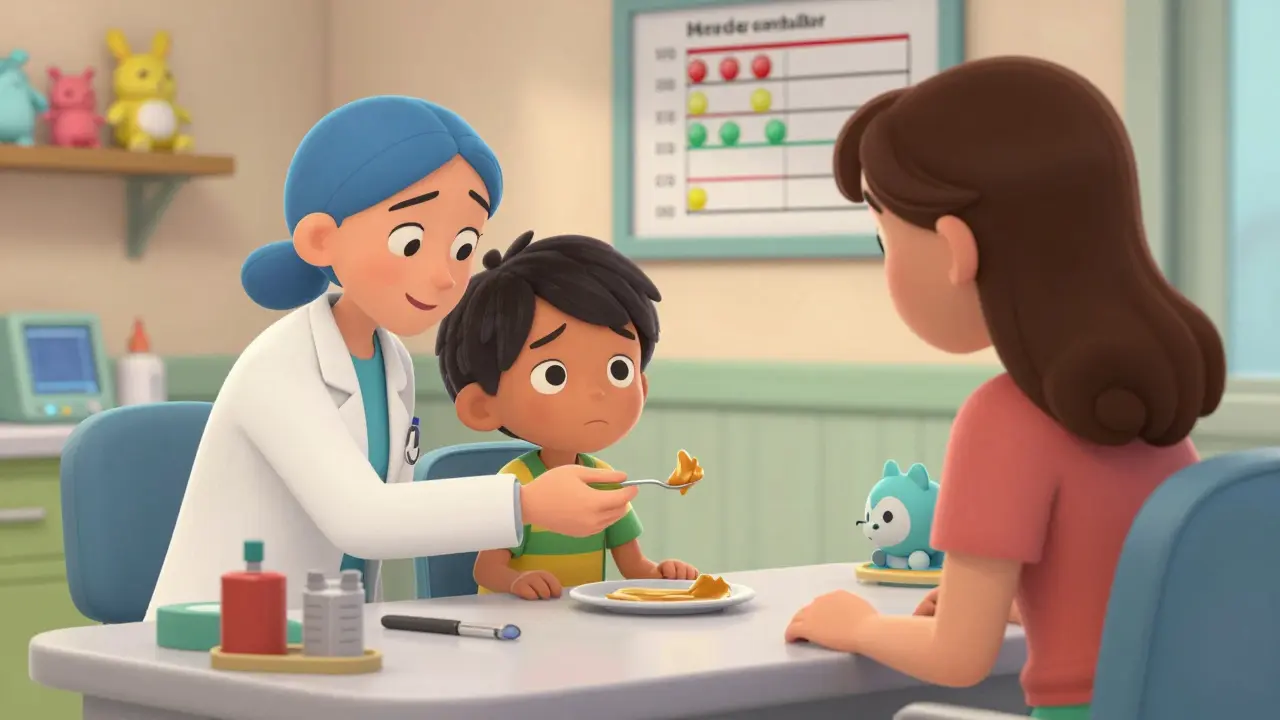
The process sounds simple, but it’s tightly controlled. You start with a tiny amount - often just 1 to 2 milligrams of the food, which is less than 1/1000th of a peanut. That’s not even enough to taste. If there’s no reaction after 15 to 30 minutes, the dose increases. This continues, step by step, until either you reach a full serving (which could be a tablespoon of peanut butter or a whole boiled egg) or a reaction occurs. The entire test takes 3 to 6 hours. Most of that time is spent waiting and watching. You’re not just sitting there, though. Medical staff monitor your vital signs, check for skin changes, listen to your lungs, and ask you how you feel. Even mild symptoms like a few hives or a scratchy throat are recorded. If a reaction happens, treatment starts immediately - antihistamines, steroids, or epinephrine, depending on severity. There are three ways to do it:- Open challenge: You know what you’re eating. This is the most common - used in about 90% of cases.
- Single-blind: Only the doctor knows what’s being given. Used when anxiety might affect the result.
- Double-blind placebo-controlled: Neither you nor the doctor knows if it’s the real food or a placebo. This is the most accurate, but it’s rarely used outside research because it’s complex and expensive.
Who Needs an Oral Food Challenge?
OFCs aren’t for everyone. But they’re essential for three situations:- Unclear allergy history: If you’ve had a mild reaction once but aren’t sure if it was an allergy or something else - like food intolerance or a stomach bug - an OFC clears it up.
- Testing for outgrown allergies: About 65% of children outgrow milk or egg allergies by age 5. But without an OFC, parents and doctors won’t know for sure. Many kids stay on elimination diets for years longer than needed.
- Confirming a diagnosis before reintroducing a food: If your child’s blood test was positive for peanut allergy but they’ve never had a real reaction, an OFC might show they’re fine. That’s a life-changing result.
Safety: How Risky Is It?
The biggest fear? Having a reaction during the test. And yes, it can happen. But here’s what most people don’t realize: most reactions are mild. About 40 to 60% of OFCs result in symptoms like hives, itching, or mild stomach upset. These are easily treated in the clinic. Severe reactions requiring epinephrine? That happens in only 1 to 2% of cases - and only when the challenge is done properly, with trained staff and emergency equipment on hand. Nationwide Children’s Hospital data from 2022 shows that when protocols are followed, the risk of life-threatening reactions is extremely low. Clinics must have epinephrine, oxygen, IV fluids, and at least two trained staff members present - one doctor and one nurse. The AAAAI says no one should perform an OFC unless they’ve supervised at least 10 challenges first. That’s not optional. It’s mandatory. The risk isn’t in the procedure. It’s in skipping it. People who avoid foods unnecessarily often develop nutritional deficiencies, social anxiety, or even worse - they end up having a severe reaction the first time they accidentally eat the food, because they never learned their true tolerance level.What to Expect Before, During, and After
Preparation matters. You need to stop antihistamines 5 to 7 days before the test. They can hide symptoms and make the results useless. If you’re sick - even with a cold - the test gets postponed. Respiratory infections can make reactions worse. On the day of the challenge:- Wear loose, comfortable clothes.
- Bring distractions - books, tablets, coloring books for kids.
- Make sure the child (or adult) is well-rested.
- Don’t eat a big meal right before - a light snack is fine.
How OFC Compares to Other Tests
Let’s be clear: skin prick tests and IgE blood tests aren’t useless. But they’re not definitive.| Test Type | Accuracy | Pros | Cons |
|---|---|---|---|
| Oral Food Challenge (OFC) | Near 100% | Definitive result, measures threshold, confirms tolerance | Time-consuming, requires medical supervision, risk of reaction |
| Skin Prick Test | 50-60% | Quick, inexpensive, widely available | High false positive rate, doesn’t measure severity |
| Serum IgE Blood Test | 33-100% (varies by food) | Good for monitoring changes over time | Cannot predict reaction severity, high false positives |
| Component-Resolved Diagnostics | Up to 85% | Can identify specific proteins causing allergy | Still can’t replace OFC; expensive, not widely available |
Who Performs Oral Food Challenges?
Only board-certified allergists - or allergists-in-training under supervision - should do OFCs. They’re not a routine lab test. They’re a medical procedure, like an endoscopy or biopsy. Major hospitals like Cleveland Clinic, Mayo Clinic, and Children’s Hospital of Philadelphia run hundreds of these each year. Private allergists typically do 50 to 200 per year, depending on their patient load. Insurance usually covers OFCs when ordered by a specialist, but you need a clear medical reason. If your doctor says “we think your child might be allergic,” that’s not enough. You need a documented history of possible reaction or an inconclusive lab test.What’s Changing in 2026?
The field is evolving. In early 2023, the NIH launched a study to create safer, more precise dosing protocols for high-risk foods like tree nuts and shellfish. The goal? Reduce reaction rates during challenges without losing diagnostic accuracy. The biggest shift? Home-based OFCs. The AAAAI updated its guidelines in January 2023 to allow carefully selected low-risk challenges to be done at home - under strict supervision and with emergency medication on hand. This isn’t for everyone. Only for patients with a known mild reaction history, stable health, and a clear plan with their allergist. Experts like Dr. Kari Nadeau at Stanford say OFCs will remain the gold standard for decades. No blood test, no AI algorithm, no new biomarker will replace the real-world test of eating the food and seeing what happens.Final Thoughts: The Real Cost of Guessing
Every year, 32 million Americans live with food allergies. Many of them avoid foods they don’t need to. Others live in fear because they never got a real diagnosis. An oral food challenge isn’t just a medical test. It’s a path to freedom - from anxiety, from isolation, from unnecessary restrictions. It’s not easy. It’s not quick. But if you’ve ever wondered whether your child’s rash after eating yogurt was an allergy - or just a coincidence - the answer is worth the wait.Don’t guess. Don’t assume. Don’t rely on a blood test that’s wrong half the time. If you’re unsure about a food allergy, ask your allergist about an oral food challenge. It’s the only test that gives you the truth.

Vicky Zhang
January 15, 2026 AT 11:06My son was terrified of peanut butter for three years because of a false positive blood test. We did the oral challenge and he passed with flying colors. Now he eats peanut butter sandwiches before school and we don’t have to read every ingredient label like it’s a military code. This test didn’t just change his diet-it changed our whole family’s life.
Allison Deming
January 16, 2026 AT 11:06It is deeply concerning that so many medical professionals continue to rely on unreliable diagnostic tools such as skin prick tests and IgE serology when the gold standard-oral food challenge-is both well-documented and widely endorsed by every major allergological society. The persistence of these outdated practices reflects a systemic failure in clinical education and a troubling prioritization of convenience over patient safety. We are not merely misdiagnosing individuals; we are institutionalizing fear under the guise of precaution.
Susie Deer
January 17, 2026 AT 19:02Why are we even talking about this like its a choice? If you wanna know if you allergic you eat the damn food in front of a doc. No blood test no skin poke no guessing. Just do the test. Its 2026 not 1998.
TooAfraid ToSay
January 19, 2026 AT 11:33Let me guess-next they’ll tell us the moon landing was real and the Earth isn’t flat. Oral food challenges? Sure. Why not just force people to eat peanut butter while wearing a tinfoil hat and chanting ‘I am not allergic’? The real conspiracy is that big pharma doesn’t want you to know that allergies are just your body’s way of saying ‘I’m tired of your processed garbage.’
Dylan Livingston
January 19, 2026 AT 21:13How quaint. We’ve reduced the profound complexity of immunological reactivity to a quaint little snack test, as if the human body were a toaster that either works or doesn’t. And yet, we still expect it to function with the precision of a Swiss watch while being fed gluten-laced oatmeal, soy-infused dairy, and genetically modified peanuts-all while being bombarded with glyphosate and EMFs. The irony is delicious: we’ve outsourced our biological intuition to a clinic waiting room and call it ‘science.’
Andrew Freeman
January 20, 2026 AT 17:06my kid did the challenge and turned out fine but now every parent at the playground acts like i just won the lottery. like ‘oh wow so you mean he can eat pizza now??’ yeah and also breathe and walk and not cry every time someone opens a peanut butter jar
says haze
January 20, 2026 AT 21:41The entire framework of food allergy diagnosis is a symptom of late-stage biomedical reductionism-where we mistake statistical correlation for biological causation, and then weaponize uncertainty to control behavior. The OFC isn’t just a diagnostic tool; it’s an act of epistemological rebellion against the tyranny of the lab report. It forces the body to speak for itself, unmediated by the sterile, profit-driven language of IgE titers. This is medicine returning to its roots: observation, patience, and the radical humility of letting the patient’s physiology decide.
Alvin Bregman
January 21, 2026 AT 02:05i get why people are scared of the challenge but honestly its way less scary than living with the fear all the time. my cousin did it for eggs and now she bakes for her whole family. no more hiding in the corner at birthday parties. i think more docs should just say ‘try it, we got your back’ instead of saying ‘avoid everything’
Sarah -Jane Vincent
January 22, 2026 AT 02:18Oral food challenges? Please. That’s just what they want you to think. The real reason they push OFCs is because they’re paid by the hour and insurance reimburses more for procedures than for counseling. Meanwhile, the real solution is detoxing your gut with colloidal silver and eating ancestral diets. You think they want you to know that? Of course not. The FDA, AAP, and WHO are all in bed with Big Food and Big Pharma. The challenge isn’t about safety-it’s about control.
Henry Sy
January 22, 2026 AT 14:24yo i did the peanut challenge last year and it was the most stressful 4 hours of my life. i was sweating like i was in a sauna and my hands were shaking. but when they said i was fine? i screamed. like actual loud scream. my doc looked at me like i lost it. i didn’t care. i ate a whole jar of peanut butter on the way home. best. day. ever.