
Opioid Rotation: How Switching Medications Can Reduce Side Effects
Opioid Rotation Calculator
Calculate Opioid Conversion
Enter your current opioid and dose to see the equivalent dose.
Important Safety Notes: Opioid rotation requires 25-50% dose reduction due to incomplete cross-tolerance. Always start lower and increase slowly under medical supervision.
When opioids stop working the way they should-either because the pain isn’t controlled anymore or the side effects become unbearable-many patients and doctors turn to opioid rotation. This isn’t about giving up on pain relief. It’s about finding a better fit. Switching from one opioid to another can cut down on nausea, drowsiness, constipation, or even confusion, without sacrificing pain control. And surprisingly, it often works even when higher doses haven’t.
Why Opioid Rotation Isn’t Just a Last Resort
People often think if an opioid isn’t working, you just crank up the dose. But that’s not always true. For many, increasing the dose makes side effects worse without helping the pain. That’s where opioid rotation comes in. It’s not about failure. It’s about biology. Everyone’s body processes drugs differently. What works for one person might cause terrible side effects in another-even at the same dose. Research shows that between 50% and 90% of patients who switch opioids report fewer side effects or better pain control. That’s not a small number. It means for most people who try it, something changes for the better. The key isn’t just swapping one pill for another. It’s doing it right.When Doctors Recommend a Switch
Opioid rotation isn’t done on a whim. It’s guided by clear clinical reasons. Here are the main ones doctors look for:- Intolerable side effects: Think constant nausea, vomiting, dizziness, muscle twitching, or mental fogginess that doesn’t improve over time.
- Poor pain control despite high doses: If you’ve doubled or tripled your dose and the pain hasn’t budged, it’s time to consider a different drug.
- Drug interactions: Some opioids clash with other medications you’re taking, increasing risks like breathing problems or sedation.
- Changing health status: If your kidneys or liver aren’t working as well, your body can’t clear the opioid the same way. A switch might be safer.
- Need for a different route: Maybe you can’t swallow pills anymore, or IV access is needed. A different opioid might be available in a form that works better for you.
Which Opioids Work Best for Reducing Side Effects?
Not all opioids are the same. Some are better than others at cutting specific side effects. For example:- Oxycodone: Often easier on the stomach. Many patients report less nausea and vomiting after switching from morphine.
- Fentanyl: Especially useful if you’re on patches or injections. It’s less likely to cause constipation or clouded thinking than morphine.
- Methadone: This one’s different. It doesn’t just swap out side effects-it often lets you take less overall. Studies show methadone can reduce your total daily opioid dose by 20-40% while keeping pain under control. Why? Because methadone works on more than one pain pathway in the brain. It’s also long-lasting, so you don’t need to take it as often.
The Danger Zone: Getting the Dose Wrong
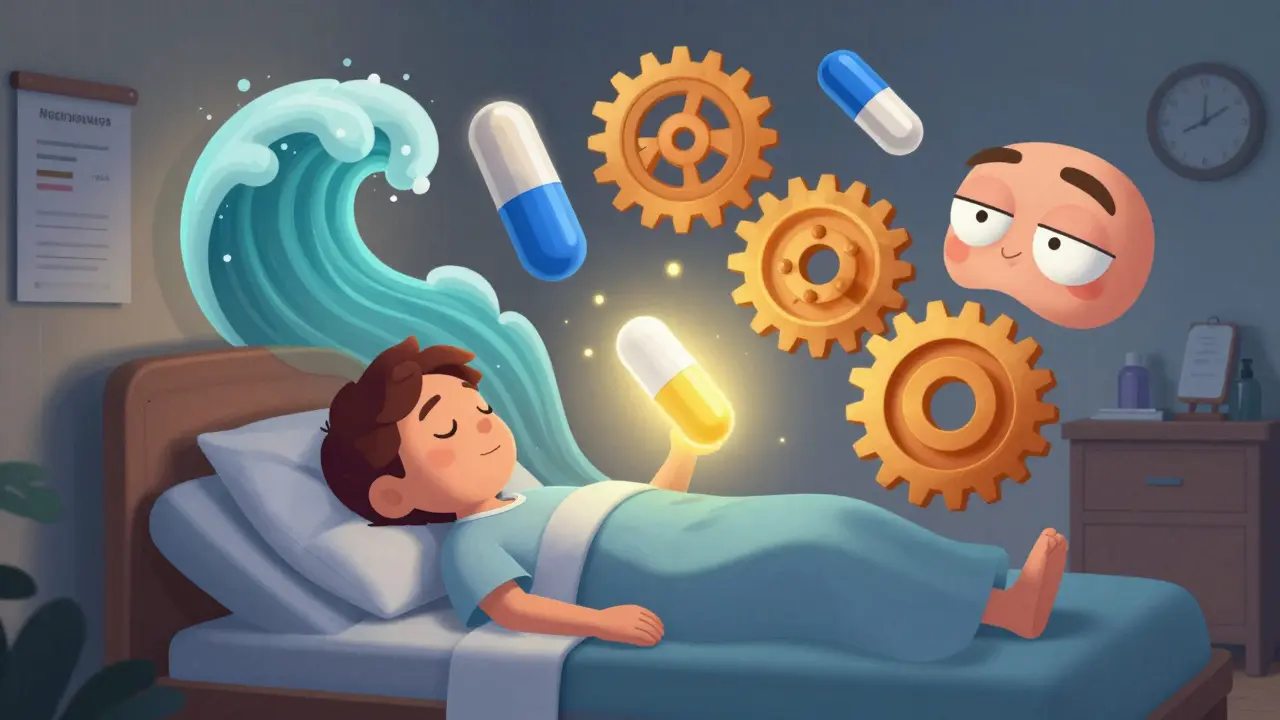
This is where opioid rotation can go wrong. You can’t just take the same dose of the new drug and call it a day. Your body isn’t fully tolerant to the new opioid right away. That’s called incomplete cross-tolerance. If you give someone 100% of the equianalgesic dose, you risk overdose. That’s why most guidelines recommend reducing the new opioid’s starting dose by 25% to 50%. For example, if your morphine dose converts to 30 mg of oxycodone, you might start with only 15-22.5 mg. Then you slowly adjust based on how you feel. This is especially true with methadone. Because it builds up in your system over days, even a small miscalculation can be dangerous. That’s why doctors often start with 30-50% of the calculated dose and wait several days before adjusting.Why Methadone Is a Game-Changer
Methadone keeps coming up in research because it does something other opioids don’t: it often lowers your total daily opioid dose. That’s huge. Lower doses mean fewer side effects, less risk of dependence, and better long-term safety. In one study of outpatient palliative care patients, those who switched to methadone consistently saw their Morphine Equivalent Daily Dose (MEDD) drop. Everyone else? Their dose stayed the same or went up. Methadone’s unique structure lets it bind to multiple receptors in the brain, giving stronger pain relief with less total drug. That’s why it’s becoming a go-to for complex cases. But it’s not for everyone. Methadone requires special training to prescribe. Not all doctors feel comfortable using it. And because it lasts so long, you need regular check-ins to make sure you’re not building up too much in your system.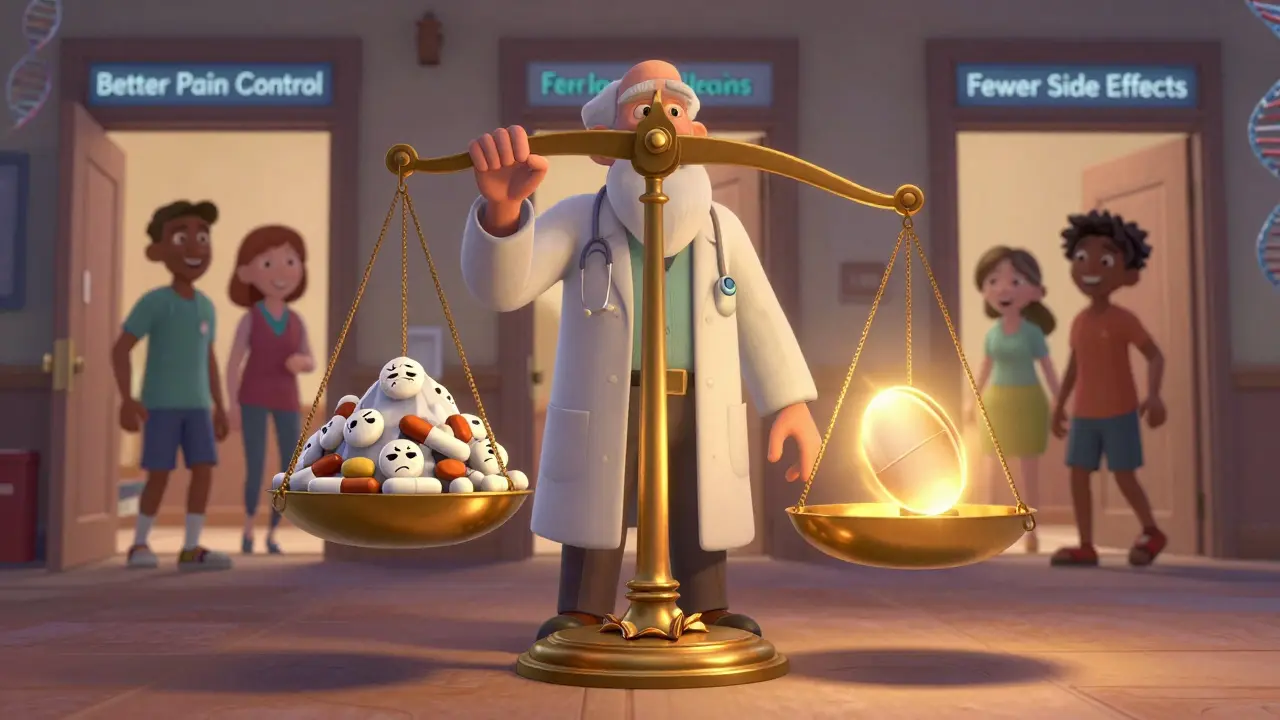
What the Research Isn’t Telling You
Here’s the uncomfortable truth: there are no big, randomized trials proving opioid rotation works better than just adjusting doses. Most of the evidence comes from watching what happens when patients switch in real life. That’s not perfect science-but it’s what we have. Some experts wonder: is the improvement because we switched drugs, or because we lowered the dose? Maybe it’s both. The act of rotating often forces a dose reduction, which itself reduces side effects. But even when doses are kept the same, patients still report feeling better. That suggests the drug itself matters. Another gap: we still don’t know why some people respond to one opioid and not another. Genetics might play a role. Some people have gene variants that make them metabolize opioids faster or slower. That could explain why one person gets dizzy on codeine and another doesn’t. Right now, we’re guessing. In the future, genetic testing might tell us which opioid to try first.What You Can Do
If you’re on opioids and struggling with side effects, here’s what to do:- Track your symptoms. Write down when you feel nauseous, sleepy, or confused. Note the time and dose.
- Don’t stop or change your dose on your own. Talk to your doctor.
- Ask: “Could opioid rotation help me?” Be ready to explain what’s not working.
- Ask about methadone. It’s not a last resort-it’s a smart option for many.
- Make sure your doctor uses a conservative conversion ratio and reduces the new dose by at least 25%.
The Bottom Line
Opioid rotation is one of the most underused tools in chronic pain management. It’s not magic. But for many, it’s the difference between suffering through side effects and getting back to daily life. The key is doing it safely-with careful dosing, clear goals, and ongoing monitoring. The 2009 guidelines are still the gold standard. They haven’t been replaced because the science hasn’t caught up. But we’re getting closer. With better tools, smarter conversions, and more attention to individual biology, opioid rotation will become more precise-and more effective.For now, if you’re stuck with side effects that won’t go away, ask your doctor about rotation. It might be the next step you didn’t know you needed.
doug b
January 29, 2026 AT 04:17Opioid rotation isn't magic, but it's one of the few things that actually gave me back my life. Went from morphine hell to oxycodone and suddenly I could sleep without vomiting. No hype, just facts.
Mel MJPS
January 29, 2026 AT 13:44This is the kind of info I wish my doctor had shared sooner. I’ve been stuck on the same dose for years thinking I just had to ‘tough it out.’ Turns out my body just needed a different key.
Jess Bevis
January 30, 2026 AT 07:07Methadone saved me. Less pills. Less fog. More walking my dog.
Jeffrey Carroll
January 30, 2026 AT 19:17The clinical rationale behind opioid rotation is profoundly underappreciated in primary care settings. The pharmacokinetic variability among individuals necessitates a personalized approach that transcends the one-size-fits-all dosing paradigm. Research consistently demonstrates improved tolerability profiles with strategic rotation, particularly when guided by equianalgesic conversion protocols that account for incomplete cross-tolerance. A 25-50% dose reduction is not conservative-it is medically essential.
Moreover, the underutilization of methadone is a systemic failure. Its multimodal receptor activity and prolonged half-life offer not only superior analgesic efficiency but also a demonstrable reduction in total daily opioid burden. This is not anecdotal; it is evidenced in palliative care cohorts across multiple longitudinal studies.
Physicians must be educated not only on conversion ratios but also on the pharmacodynamic uniqueness of methadone. The 9:1 ratio for side effect mitigation is not arbitrary-it is a reflection of its NMDA antagonism and serotonin reuptake inhibition, properties absent in traditional mu-opioid agonists.
The absence of large-scale RCTs does not invalidate real-world outcomes. In chronic pain, where placebo-controlled trials are ethically fraught, pragmatic evidence remains the gold standard. We must shift from demanding perfect data to applying what works for real people.
For patients: track symptoms meticulously. Document timing, intensity, and correlation with dosing. This data is your most powerful tool in advocating for rotation. Do not accept suffering as inevitable.
Kevin Kennett
January 31, 2026 AT 07:19Y’all act like opioid rotation is some secret hack, but it’s literally the first thing we’re taught in pain management residency. The fact that so many patients are stuck on morphine for years is a failure of the system, not the medicine.
I had a guy on 180mg morphine daily with constant nausea and confusion. Switched him to fentanyl patch + low-dose methadone. He’s now at 45mg MEDD, sleeping through the night, and playing with his grandkids. No miracle. Just science.
Stop treating pain like a one-drug-fits-all problem. Your body isn’t a vending machine.
Phil Davis
January 31, 2026 AT 13:07So let me get this straight. We’ve known for decades that switching opioids reduces side effects, but doctors still act like it’s a last resort? Like they’re afraid to try something that actually works? Maybe if they stopped treating pain patients like addicts, they’d stop treating pain like a puzzle they’re too scared to solve.
Also, methadone. Everyone’s scared of it. Meanwhile, I’ve been on it for 8 years and my liver’s better than yours.
Rose Palmer
February 1, 2026 AT 23:49It is imperative to underscore that opioid rotation, when executed in accordance with established clinical guidelines, constitutes a cornerstone of evidence-based chronic pain management. The pharmacological heterogeneity among opioid agents necessitates individualized therapeutic strategies predicated upon metabolic profiling, receptor affinity, and pharmacokinetic clearance. The prevailing reluctance to implement rotation reflects a systemic deficit in provider education, rather than a deficiency in therapeutic utility.
Furthermore, the underutilization of methadone is not merely an oversight-it is a public health liability. Its unique pharmacodynamic profile, including NMDA receptor antagonism and serotonin-norepinephrine reuptake inhibition, confers analgesic efficacy that cannot be replicated by conventional mu-opioid agonists. The conservative conversion ratios recommended in the 2009 guidelines remain clinically valid and are supported by contemporary pharmacovigilance data.
Patients must be empowered through transparent communication. The assertion that rotation signifies therapeutic failure is not only inaccurate, but actively detrimental to patient outcomes. It is, rather, a sophisticated recalibration of treatment intent.
Mindee Coulter
February 3, 2026 AT 03:11Howard Esakov
February 4, 2026 AT 08:45Look, I’ve read the 2009 guidelines. I’ve seen the papers. But let’s be honest-most of these ‘success stories’ are just people who got lucky with a lower dose. Methadone’s ‘magic’? It’s just slow accumulation. You’re trading one risk for another. And don’t get me started on how many people die because some GP thought 9:1 was a good place to start.
Real talk: if you’re on opioids long-term, you’re already playing Russian roulette. Rotation just changes the chamber.
Also, I’m not impressed by your ‘research.’ I’ve seen more patients crash on methadone than I’ve seen thrive. Just sayin’.
Rhiannon Bosse
February 5, 2026 AT 11:17Okay but… what if this is all a pharmaceutical scam? Think about it. They make one opioid, you get side effects, so they push you to another one. Then another. Then another. All while charging you more. Who profits? The drug companies. Who pays? You. Your liver. Your dignity.
And methadone? It’s literally a drug used to treat addiction. Why are they pushing it for pain? Are they trying to normalize dependency? Are we being turned into walking pharmacology experiments?
I used to trust doctors. Now I just take ibuprofen and pray.
Brittany Fiddes
February 6, 2026 AT 23:27Oh, so now we’re supposed to believe this is science? In Britain, we’ve known for decades that opioid rotation is just a fancy way to keep patients hooked. And methadone? That’s just heroin with a lab coat.
They don’t care about your pain. They care about your prescription count. Look at the numbers-every time they ‘rotate,’ the opioid sales go up. Coincidence? I think not.
My cousin went on rotation. Now he’s on three drugs and can’t remember his daughter’s name. That’s not progress. That’s corporate medicine.
matthew martin
February 8, 2026 AT 21:24My grandma switched from morphine to oxycodone and suddenly she was laughing again. Not because the pain vanished, but because she could finally watch her shows without feeling like she was drugged on a bus.
Doctors treat us like we’re broken machines. But we’re people. We need to feel like ourselves again. Opioid rotation isn’t about finding the strongest pill. It’s about finding the one that lets you live.
Also, methadone? My uncle’s been on it for 12 years. He’s a retired mechanic who fixes cars on weekends. That’s not a failure. That’s a win.
Stop overcomplicating it. If your meds make you feel like a zombie, ask for a change. That’s not weakness. That’s wisdom.
John Rose
February 10, 2026 AT 11:32One thing I’ve noticed-every time someone says ‘methadone reduces total dose,’ they never mention how hard it is to get prescribed. Most pain clinics won’t touch it. Why? Because it’s cheap. And the system doesn’t profit from cheap. It profits from expensive, frequent refills.
Also, genetics? We’re talking about gene variants that affect opioid metabolism. That’s not sci-fi. It’s real. Some people are ultra-rapid metabolizers. Codeine turns into morphine too fast. That’s why they overdose. But we don’t test for it. Why? Because it costs money.
This isn’t just about side effects. It’s about access. And equity. And whether your doctor believes you’re worth the extra effort.
Irebami Soyinka
February 10, 2026 AT 12:35USA always think they invented medicine 😂 Nigeria we use traditional herbs and still live longer than you! 😎 You people take 10 pills just to sit on toilet and still cry! 🤣 Methadone? We call it ‘poison for lazy minds’ 🤭
My uncle took papaya leaf juice, ginger tea, and coconut water-no opioid, no hospital, no drama. He walks 10km every day. You? You can’t walk to fridge because your brain is full of pills 🤡
Stop selling fear. Start selling truth. Africa don’t need your fancy drugs. We need your humility 😌