
Excipients in Generics: How Inactive Ingredients Affect Tolerance and Health
When you pick up a generic pill at the pharmacy, you assume it’s the same as the brand-name version. Same active ingredient. Same effect. Same safety. But what if the real difference isn’t in what the pill does - but in what it’s made of?
What Are Excipients, Really?
Excipients are the ingredients in your medication that don’t treat your condition. They’re called "inactive" - but that’s misleading. They’re not useless. They help the drug dissolve, hold its shape, last longer on the shelf, or taste less bitter. Think of them like the scaffolding around a building. You don’t pay for the scaffolding, but without it, the building falls apart.
Common excipients include lactose (a milk sugar), magnesium stearate (a lubricant), croscarmellose sodium (a disintegrant), and artificial colors like FD&C Blue #2 or Yellow #5. The average oral pill contains 8.8 of these ingredients. Some have more than 20. And here’s the catch: 90.2% of all oral medications contain at least one excipient linked to adverse reactions in sensitive people.
That’s not a typo. Nearly every pill you take might contain something that could make you sick - even if the active ingredient is perfectly safe for you.
Why Generic Pills Can Feel Different
The FDA requires generic drugs to be bioequivalent to the brand version. That means they deliver the same amount of active ingredient into your bloodstream at roughly the same speed. But there’s no rule saying they have to use the same fillers, binders, or dyes.
Take Synthroid, a thyroid medication. The brand version uses a specific mix of excipients. A generic version might swap lactose for corn starch, or ditch artificial coloring entirely. Sounds harmless, right? Not always.
Patients switching from brand to generic - or even between two different generics - report sudden bloating, diarrhea, headaches, rashes, or brain fog. One Reddit user, u/MedicCheck, described severe stomach pain after switching to a generic version of Synthroid. Turns out, the new pill contained FD&C Blue #2 - a dye they were allergic to. The active ingredient? Identical. The side effects? Real.
A 2021 study found that 73.5% of pharmacists had patients complain about unexpected reactions after switching to a generic. These aren’t placebo effects. These are real intolerance reactions.
The Hidden Triggers: Top Excipients That Cause Problems
Not all excipients are equal. Some are far more likely to cause trouble than others. Here are the most common culprits:
- Lactose: Found in 40-60% of oral tablets. Even small amounts - as little as 1-2 grams - can trigger bloating, gas, cramps, and diarrhea in lactose-intolerant people. Most people think they’re fine if they can drink milk, but pill doses are concentrated. A single tablet might contain 100-500 mg. For sensitive individuals, that’s enough.
- Artificial Colors: Yellow #5 (tartrazine) and Blue #2 (indigotine) are linked to hives, asthma, and hyperactivity in children. Some adults report migraines or anxiety after exposure.
- Parabens: Used as preservatives. Can cause skin rashes or allergic reactions, especially in people with eczema or sensitive skin.
- Polysorbate 80: A solubilizer found in some generics. Linked to immune reactions in rare cases.
- Gluten: Not always labeled. Some generics use wheat starch as a filler. For celiac patients, even trace amounts can cause intestinal damage.
The FDA’s Inactive Ingredient Database lists over 1,500 excipients and their approved uses. But it doesn’t tell you which ones are in your specific pill unless you dig for it.
Why Doctors and Pharmacies Don’t Always Warn You
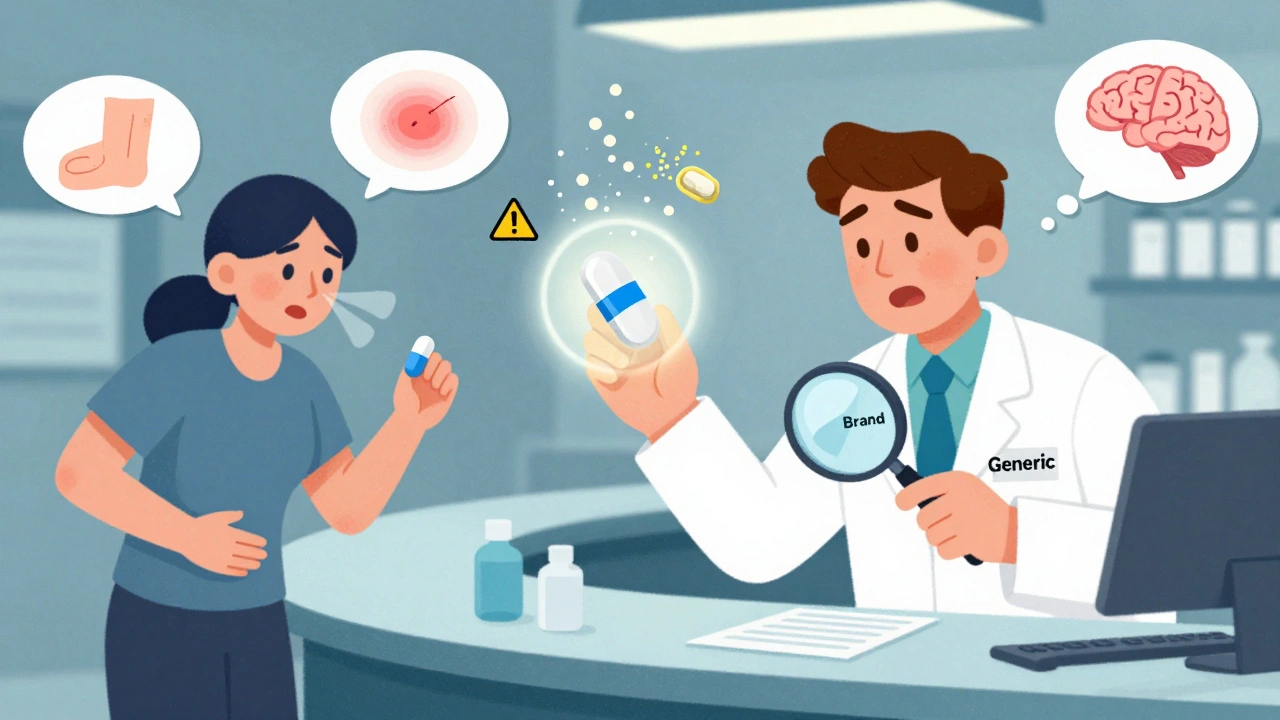
Most doctors don’t ask about excipient sensitivities. Why? Because they’re not trained to. Medical school barely covers pharmaceutical formulation. Pharmacists know more - but they’re busy. On average, a pharmacist spends just 7.2 minutes per patient investigating possible excipient issues.
Brand-name drugs usually list every ingredient on the packaging. Generics? Not always. Some manufacturers only provide full ingredient lists upon request. You might need to call the company directly.
And here’s the kicker: if you react to a generic, your doctor might assume you’re "not compliant" or "overreacting." Only 22.7% of providers in one survey documented the intolerance. Most just shrugged it off.
What You Can Do: A Practical Guide
You don’t have to guess. You don’t have to suffer. Here’s how to take control:
- Track your symptoms. Did your rash start after switching pills? Did your stomach cramps begin after a new prescription? Write down the date, the drug name, and what you felt.
- Look up the ingredients. Use the FDA’s Inactive Ingredient Database or the Pillbox tool from the National Library of Medicine. Search by drug name or manufacturer.
- Ask your pharmacist. Say: "Can you tell me what excipients are in this generic version?" They can check the manufacturer’s product monograph.
- Compare versions. If you’re switching from brand to generic, or between generics, compare the ingredient lists side by side. Look for new dyes, fillers, or preservatives.
- Document it. Tell your doctor. Write it in your medical record. "Patient intolerant to lactose in generic levothyroxine. Switched to dye-free version with no adverse effects."
Some pharmacies now offer "excipient-free" or "sensitive formulation" options. Ask for them. They exist.
The Bigger Picture: Why This Matters
Generics save the U.S. healthcare system over $300 billion a year. That’s huge. But cost savings shouldn’t come at the cost of safety.
People with chronic conditions - thyroid disease, epilepsy, depression - rely on consistent dosing. If a change in excipients alters absorption, triggers inflammation, or causes nausea, they may stop taking the drug. That’s when things get dangerous.
There’s a quiet revolution happening. The FDA launched its Excipient Safety Modernization Initiative in 2023 to collect patient-reported data. MIT is building AI tools that predict your tolerance based on your genetics. By 2025, electronic prescriptions may be required to show full excipient lists.
And the market is responding. The global market for lactose-free, dye-free, gluten-free generics hit $18.7 billion in 2022 - and it’s growing fast. Companies are starting to listen.
Final Thought: Inactive Doesn’t Mean Harmless
Just because an ingredient doesn’t cure your condition doesn’t mean it’s safe for you. Excipients are not filler. They’re functional. And for some people, they’re the reason a medication fails.
You have the right to know what’s in your pill. You have the right to ask for a version that doesn’t trigger your body. And you’re not alone. Thousands of people have been misdiagnosed, dismissed, or told to "just tough it out" - when the real problem was a tiny bit of lactose, a drop of dye, or a preservative they never knew they were sensitive to.
Next time you pick up a new generic, don’t just take it. Look at it. Ask about it. Protect yourself. Your body isn’t just reacting to the drug. It’s reacting to everything in the pill.
Are excipients in generics really a problem?
Yes. While excipients don’t treat your condition, they can cause real side effects in sensitive individuals. Studies show over 90% of oral medications contain at least one excipient linked to allergies or intolerances. Reactions include bloating, rashes, headaches, and digestive distress - especially when switching between brand and generic versions or between different generic manufacturers.
Can lactose in pills cause problems if I’m lactose intolerant?
Absolutely. Even small amounts - as little as 1-2 grams - can trigger symptoms like bloating, gas, cramps, and diarrhea in sensitive people. Many generic pills contain 100-500 mg of lactose per tablet. For someone with severe intolerance, that’s enough to cause discomfort. Lactose is used in 40-60% of oral tablets, making it one of the most common triggers.
How do I find out what excipients are in my generic medication?
Check the FDA’s Inactive Ingredient Database or use the Pillbox tool from the National Library of Medicine. You can search by drug name or manufacturer. If the information isn’t clear on the packaging, call the pharmacy or the manufacturer directly. Pharmacists can often pull up the manufacturer’s product monograph, which lists every ingredient.
Should I avoid generics because of excipients?
No. Generics are safe and effective for most people. But if you’ve had unexplained side effects after switching, it’s worth investigating excipients. Many manufacturers offer "sensitive formulations" without dyes, lactose, or gluten. Ask your pharmacist for alternatives - you might find a version that works better for you without paying brand-name prices.
Is there a way to test for excipient sensitivity?
There’s no standard blood test yet. But you can identify sensitivity through elimination: stop the medication, wait for symptoms to clear, then restart under supervision. If symptoms return, compare ingredient lists between versions. You’re looking for new or changed excipients. Some research labs are developing genetic-based tools to predict sensitivity, but those aren’t widely available yet.
Can I request a brand-name drug instead of a generic?
Yes. If you’ve documented a reaction to excipients in generics, your doctor can write "Do Not Substitute" or "Dispense as Written" on the prescription. Insurance may require prior authorization, but many approve it for patients with confirmed intolerance. It’s your right to ask for the version that works for your body.
Are there generic medications without artificial colors or lactose?
Yes. Many manufacturers now offer dye-free, lactose-free, and gluten-free versions of common drugs - especially for thyroid, epilepsy, and antidepressant medications. These are often labeled as "sensitive formulations" or "free-from" options. Ask your pharmacist specifically for these versions. They’re becoming more common and usually cost only slightly more than standard generics.
Why don’t drug labels list all excipients clearly?
FDA regulations don’t require full excipient disclosure on consumer packaging - only on the manufacturer’s product monograph. Brand-name drugs often list more because of marketing transparency. Generics, especially those made by smaller companies, may only provide full details upon request. This lack of visibility is why patients often don’t realize excipients are the cause of their reactions.
What’s being done to fix this issue?
The FDA launched its Excipient Safety Modernization Initiative in 2023 to collect patient-reported data and update safety guidelines. By 2025, electronic prescriptions may be required to include full excipient lists. The European Medicines Agency and other global regulators are also tightening standards. Pharmaceutical companies are investing in excipient databases, and some are already offering personalized formulations.
How can I help raise awareness about excipient safety?
Document your experience. Tell your doctor and pharmacist. Share your story with patient advocacy groups. Ask your pharmacy to track excipient-related complaints. The more data collected, the faster regulators and manufacturers will respond. You’re not just protecting yourself - you’re helping improve the system for everyone.




Ben Greening
December 9, 2025 AT 18:28The data here is alarming-and completely under-discussed in mainstream medicine.
I’ve seen patients develop unexplained rashes after switching generics, and no one ever connected it to FD&C Yellow #5 until they dug into the pill’s ingredients.
Doctors don’t learn formulation in med school. Pharmacists are overworked. Patients are left guessing.
This isn’t conspiracy. It’s pharmacology 101-and we’re treating it like a footnote.
Doris Lee
December 10, 2025 AT 06:04Thank you for writing this. I’ve been telling my doctor for years that my migraines started after my Synthroid switched generics. She thought I was being dramatic.
Turns out it was Blue #2. I switched to a dye-free version and haven’t had a headache in 8 months.
You’re not alone. And you’re not crazy.
Neelam Kumari
December 11, 2025 AT 16:25Oh great. So now we’re supposed to become pharmaceutical chemists just to take a pill? Next they’ll ask us to test the binder for trace heavy metals.
Maybe if people stopped buying generics and demanded brand-name, the system would fix itself.
But no-let’s just add another 12 steps to the medication process. Classic.
Queenie Chan
December 11, 2025 AT 20:56It’s wild how we’ve normalized ignorance around what’s inside our pills.
We read ingredient labels on cereal, on shampoo, on laundry detergent-but when it comes to the thing we swallow to stay alive? We just assume ‘inactive’ means ‘innocent’.
Lactose in a tablet isn’t ‘a little sugar’-it’s a concentrated dose, often more than a sip of milk. And we’re surprised when someone reacts?
It’s not just about allergies-it’s about respect. Your body isn’t a lab rat. It deserves transparency.
I keep a spreadsheet now. Every new med? I log the manufacturer, the excipients, the date, the symptoms. It’s annoying. But it’s saved me from three bad reactions.
And yes-I’ve called manufacturers at 8 PM on a Tuesday. Yes, they answered. Yes, they sent me the monograph.
Stop waiting for the system to protect you. Protect yourself.
And if you’re a provider? Start asking. Just once. ‘Have you had any reactions since switching?’ It changes everything.
David Palmer
December 12, 2025 AT 07:16Bro, I just take the pill. If it works, it works. Why do you care if it’s got cornstarch or whatever?
My cousin takes 7 meds a day and she’s fine. You’re overthinking this.
Stephanie Maillet
December 12, 2025 AT 11:27There’s a quiet tragedy here: we’ve outsourced our bodily autonomy to a system that doesn’t see us as individuals.
We’re told ‘bioequivalent’ means ‘identical’-but identity isn’t just about concentration. It’s about context. It’s about the matrix in which the molecule exists.
A pill isn’t just chemistry. It’s culture. It’s history. It’s the legacy of cost-cutting disguised as progress.
And yet-we still trust it. Because what else can we do?
Maybe the real revolution isn’t in better labeling-it’s in reclaiming the right to say: ‘This isn’t working for me, and I demand to know why.’
It’s not radical. It’s human.
Nikki Smellie
December 14, 2025 AT 01:25Did you know the FDA approved a generic version of a blood thinner last year that used a dye derived from crushed beetles? And no one told patients?!
Big Pharma is hiding this. They know. They’ve known for decades. They profit from your silence.
There’s a database buried in a server in Rockville, MD, that lists every reaction-but it’s not public. Why? Because if you knew how many people are getting sick from fillers, you’d never take another pill again.
And now they’re pushing AI to predict your sensitivity? That’s not innovation. That’s surveillance.
Wake up. They’re not trying to help you. They’re trying to control you.
Michaux Hyatt
December 15, 2025 AT 13:44Just wanted to add: if you’re on levothyroxine and switched generics, check the manufacturer. My pharmacy now stocks two versions-one with lactose, one without. The lactose-free is made by a company called Aurobindo, and it’s the same price.
Ask for it by name. Don’t let them just hand you whatever’s on the shelf.
And if you’re a provider? Add ‘excipient sensitivity’ to your intake form. It takes 10 seconds. Could save someone’s life.