
Clozapine and Smoking: How Cigarettes Affect Dose Needs and Risks
Clozapine Dose Adjuster
Clozapine Dose Calculator
This tool helps determine appropriate clozapine doses based on smoking status. Always monitor therapeutic drug levels when changing smoking habits.
Recommended Dose
Recommended Dose:
Important Information: Smokers typically need 50-100% higher doses than non-smokers. When quitting, dose should be reduced by 25-30% immediately, with weekly therapeutic drug monitoring (TDM) for 2-3 weeks.
Warning: The article shows clozapine levels can rise by 29.3% on average after quitting smoking, but individual variation ranges from 10% to over 200%. Always work with your healthcare provider for personalized dose adjustments. Clozapine has a narrow therapeutic window (350-500 ng/mL).
When someone is taking clozapine for treatment-resistant schizophrenia, their smoking habit isn’t just a personal choice-it’s a medical factor that can make the difference between effective treatment and dangerous side effects. If you smoke, your body breaks down clozapine faster. If you quit, levels can spike overnight. This isn’t theory. It’s a well-documented, life-threatening interaction that happens in real time, and too many clinicians still miss it.
Why Smoking Changes Clozapine Levels
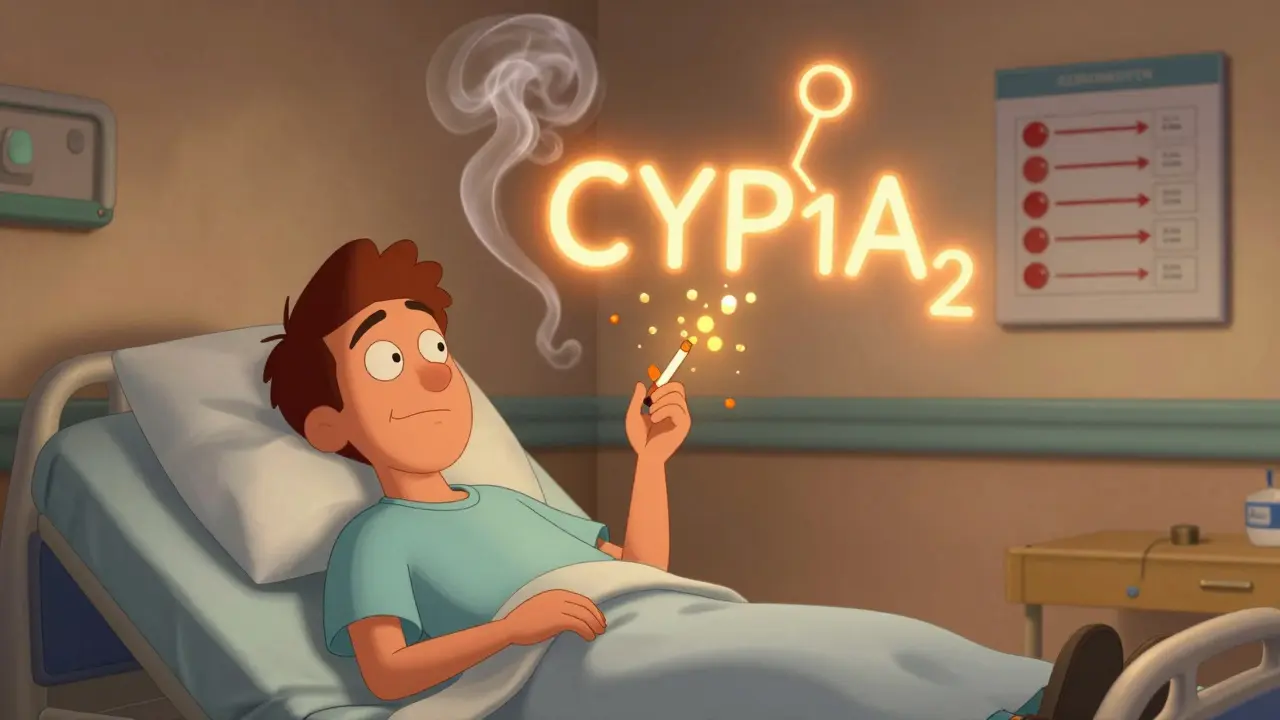
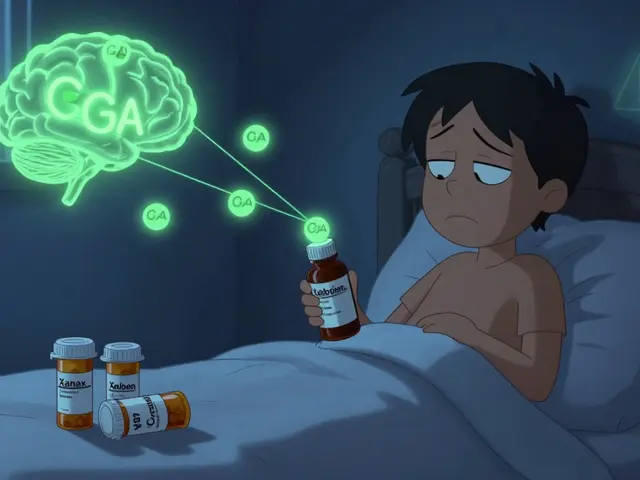
Clozapine is metabolized almost entirely by one enzyme: CYP1A2. That’s unusual. Most drugs are broken down by multiple pathways, so if one gets blocked or boosted, others can pick up the slack. Clozapine doesn’t have that safety net. Around 90% of it is processed by CYP1A2. When you smoke, the polycyclic aromatic hydrocarbons (PAHs) in cigarette smoke turn on this enzyme like a switch. Studies show CYP1A2 activity jumps by 2 to 3 times in regular smokers. That means clozapine gets cleared from your blood much faster. The numbers don’t lie. A 2003 study by Faber et al. found that smokers needed an average of 382 mg per day to stay in the therapeutic range, while non-smokers only needed 197 mg. That’s nearly double. And it’s not just about the dose-it’s about what’s happening in the bloodstream. Smokers had 2.5 times lower clozapine concentration-to-dose ratios (C/D). In plain terms: for every milligram you take, smokers get far less drug in their blood.What Happens When You Quit Smoking
This is where things get dangerous. When someone stops smoking, CYP1A2 doesn’t shut off instantly. It takes time. Studies show enzyme activity drops by 20% within two days and 36% by day seven. But clozapine doesn’t wait. It builds up fast. In hospitalized patients who quit smoking, average clozapine levels rose by 29.3% within two weeks. That might sound small, but with clozapine’s narrow therapeutic window (350-500 ng/mL), even a 20% rise can push someone into toxicity. One case from the NJM journal described a 45-year-old man who developed clozapine intoxication-serum levels hit 1,200 ng/mL-just 10 days after quitting. He ended up in intensive care. Reddit threads from psychiatrists in 2022 report similar cases: patients going from stable on 400 mg to delirious and tachycardic after quitting, with levels jumping from 350 to over 800 ng/mL in under a week. The problem? No one expects it. Patients aren’t warned. Clinicians don’t adjust. And because the change varies so wildly-from a 10% drop to a 244% increase in levels-there’s no one-size-fits-all rule. That’s why therapeutic drug monitoring (TDM) isn’t optional. It’s essential.Why Vaping Isn’t a Safe Alternative
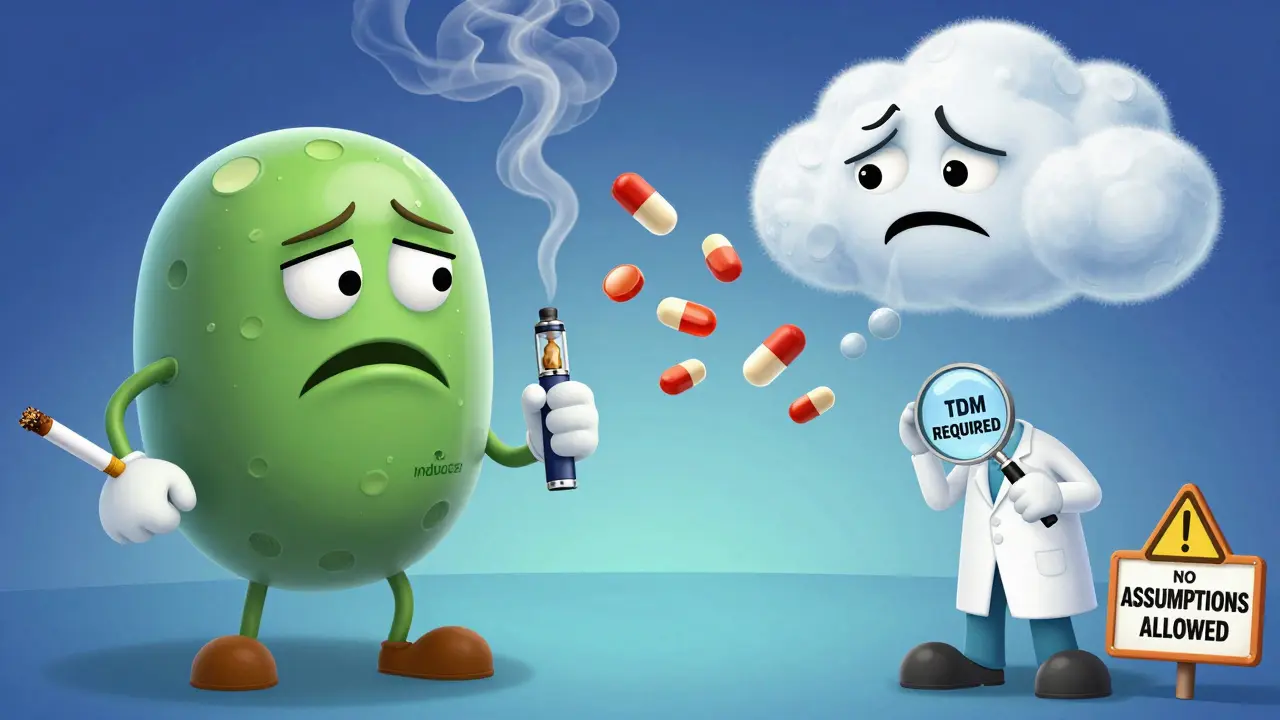
Many patients switch to vaping to quit smoking. But vaping doesn’t mean you’re off the hook. Traditional cigarettes contain PAHs from burning tobacco-those are the main CYP1A2 inducers. Vaping skips combustion, so it usually reduces enzyme induction. That means clozapine levels can rise, sometimes sharply. But here’s the twist: some vape liquids contain aldehydes and carbonyls, which can still activate CYP1A2. So a patient might switch from smoking to vaping and end up with lower clozapine levels-because the vape is still inducing the enzyme. Or they might end up with higher levels because the vape isn’t. There’s no way to predict it without testing. The Journal of Advances in Medicine and Medical Research (2022) warns that vaping creates a "clinically unpredictable" scenario. The only safe approach? Monitor levels weekly for two weeks after switching.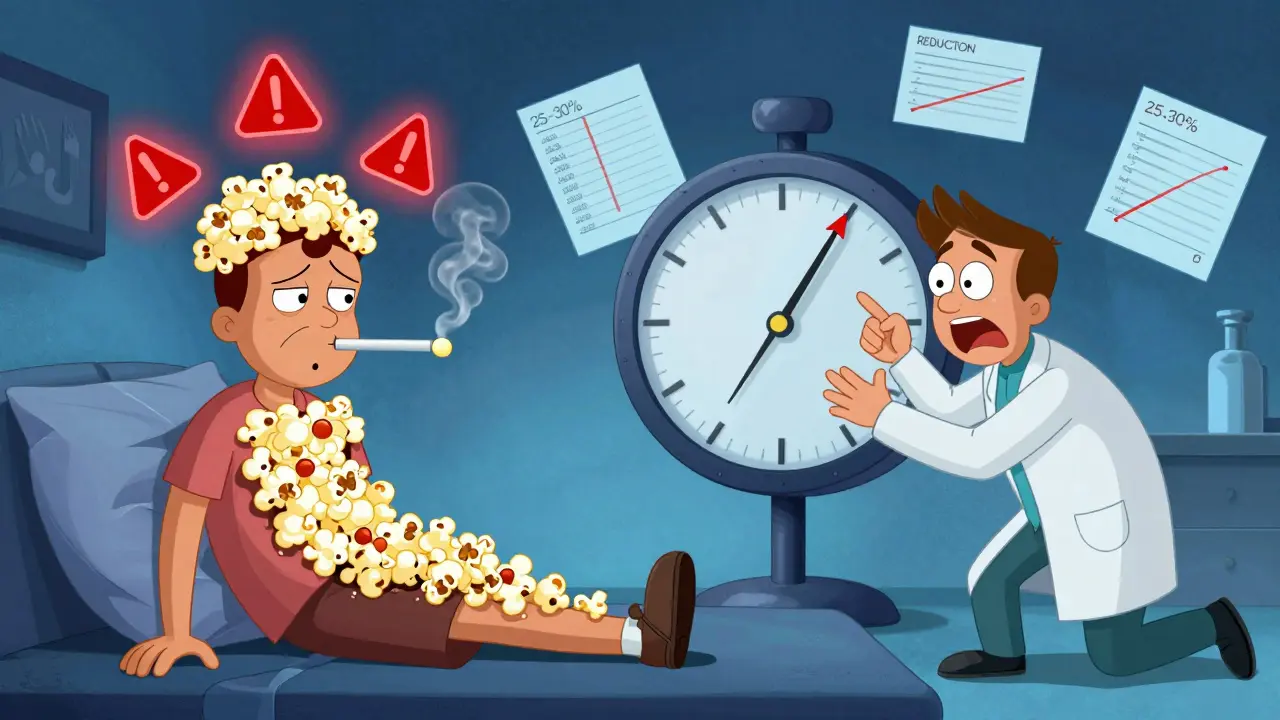
Genetics Don’t Save You
You might have heard about genetic testing for drug metabolism. The CYP1A2*1F variant (rs762551) is often discussed-people with the A allele are thought to be more responsive to induction. But here’s the surprise: the original 2003 Faber study with 80 patients found no significant link between this gene and dose needs. Smokers with the "high inducibility" genotype didn’t need higher doses than smokers without it. Non-smokers with the same gene didn’t need lower doses. That means behavior-how much you smoke, whether you quit, whether you vape-is a stronger predictor than your DNA. This is critical. If you’re relying on genetic tests alone to guide clozapine dosing, you’re missing the biggest factor: your smoking habits.How to Adjust Doses Correctly
There’s no guesswork here. The Dutch Pharmacogenetics Working Group (2022) and the American Psychiatric Association (2020) have clear guidelines:- If you smoke: Start at the standard dose, but expect to need 50-100% more than non-smokers to reach therapeutic levels. Don’t assume your dose is "too high" just because it’s over 400 mg. It might be just right.
- If you quit smoking: Reduce your dose by 25-30% immediately. Don’t wait. Don’t hope it’ll be fine. Monitor serum levels weekly for 2-3 weeks. A 2023 study in Frontiers in Psychiatry showed that 29.3% average rise happens fast-waiting two weeks to act is too late.
- If you switch to vaping: Treat it like quitting. Monitor levels weekly for two weeks. You might need to reduce, or you might need to increase. Only TDM tells you which.
And don’t forget: trough levels should be drawn 12 hours after the last dose. Timing matters. A level drawn 3 hours after a dose will look artificially high.
What Happens If You Ignore This
Ignoring this interaction isn’t just risky-it’s costly. A 2021 pharmacoeconomics study found that improper management leads to 15-20% higher hospitalization rates. Each avoidable admission costs around $12,500. But the human cost is higher. Toxicity can mean seizures, myocarditis, delirium, or even death from agranulocytosis. And if levels are too low? The patient’s psychosis returns. They might stop taking the drug. They might stop trusting their care team. One patient, described in the Journal of Clinical Psychopharmacology (2021), quit smoking and worked with their doctor to adjust doses weekly. Clozapine levels were tracked. Dose dropped from 450 mg to 250 mg over 10 days. No side effects. Symptoms stayed controlled. That’s what proper management looks like.Who’s at Risk?
About 70-85% of people with schizophrenia smoke-compared to 14% in the general population. That means most clozapine users are smokers. And when they quit, whether for health reasons, hospitalization, or personal choice, their medication becomes unpredictable. The FDA requires TDM for clozapine since 2002. But a 2022 survey in the Journal of Psychiatric Practice found only 42% of psychiatry residents could correctly calculate dose adjustments after smoking cessation. That’s not just a knowledge gap-it’s a systemic failure.What’s Next?
New tools are coming. A 2023 study showed that combining smoking history (pack-years) with CYP1A2 genotype improved dose prediction by 35%. Caffeine also matters-heavy coffee drinkers (more than 4 cups/day) need 15-20% higher clozapine doses because caffeine competes for the same enzyme. Point-of-care tests using caffeine metabolism as a biomarker are in phase 2 trials (NCT04876321). These could one day tell you your CYP1A2 activity in minutes. But right now, the answer is simple: Test. Adjust. Monitor. Don’t assume. Don’t guess. If you’re on clozapine and you smoke-or you’ve quit, or you switched to vaping-your dose isn’t set in stone. It’s a living number, tied to your behavior. And if your doctor isn’t tracking it, ask them why.Does quitting smoking always raise clozapine levels?
Almost always, but not always. On average, levels rise by 29.3% after quitting, but individual changes range from a 10% drop to over 200% increase. This variability is why weekly therapeutic drug monitoring (TDM) is required-not optional.
Can I just reduce my clozapine dose by 30% right after I quit smoking?
Yes, and you should. Waiting for symptoms or lab results is dangerous. Guidelines from the Dutch Pharmacogenetics Working Group recommend an immediate 25-30% dose reduction upon smoking cessation. But you still need TDM to fine-tune it over the next two weeks.
Does vaping affect clozapine the same way as smoking?
No. Vaping usually reduces CYP1A2 induction because it lacks the combustion products in cigarette smoke. That often causes clozapine levels to rise. But some vape liquids contain chemicals that can still induce the enzyme, so levels might drop instead. There’s no safe assumption-monitor levels weekly for two weeks after switching.
Is genetic testing useful for predicting clozapine dose needs in smokers?
Not reliably. The CYP1A2*1F gene variant was once thought to predict how much smoking affects metabolism. But a major 2003 study of 80 patients found no clinical link between this gene and dose requirements. Smoking behavior matters far more than genetics.
Why is clozapine more affected by smoking than other antipsychotics?
Because clozapine relies almost entirely on CYP1A2 for metabolism-about 90%. Other drugs like olanzapine are also metabolized by CYP1A2, but they use additional pathways. So if CYP1A2 speeds up, clozapine levels crash, while others just dip slightly. That’s why smokers need up to 100% more clozapine, but only 30% more olanzapine.


Sarah B
February 7, 2026 AT 11:29Patrick Jarillon
February 8, 2026 AT 17:15Tola Adedipe
February 9, 2026 AT 09:23Heather Burrows
February 9, 2026 AT 21:53Marcus Jackson
February 10, 2026 AT 00:31Lakisha Sarbah
February 10, 2026 AT 04:30Paula Sa
February 10, 2026 AT 17:12Joey Gianvincenzi
February 12, 2026 AT 16:41Jesse Lord
February 13, 2026 AT 04:21Niel Amstrong Stein
February 14, 2026 AT 07:35Mary Carroll Allen
February 15, 2026 AT 14:15