
Benign Prostatic Hyperplasia and Decongestants: What You Need to Know About Urinary Retention Risk

BPH Decongestant Risk Calculator
Assess Your Risk
Enter your details to get personalized risk assessment based on medical guidelines.
Your Risk Assessment
Safe Alternatives
Critical Warning
Men over 50 with an enlarged prostate-known as benign prostatic hyperplasia (BPH)-face a hidden danger when they reach for common cold and allergy meds. A single pill of pseudoephedrine, found in Sudafed and dozens of over-the-counter products, can trigger a medical emergency: acute urinary retention. This isn’t a rare side effect. It’s a well-documented, preventable crisis that sends thousands to the ER every year.
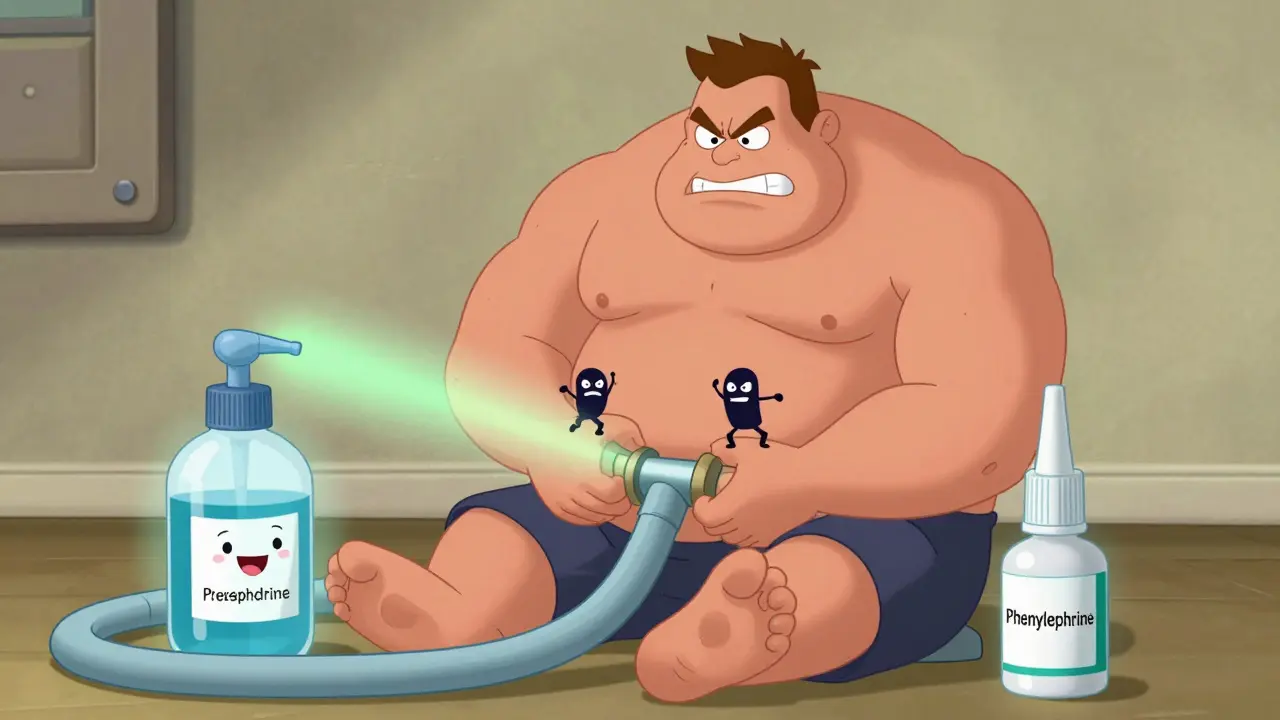
Think about it: you’ve got a stuffy nose, so you grab a decongestant. You don’t think about your prostate. But here’s the problem: the same mechanism that opens your nasal passages also tightens the muscles around your urethra. For men with BPH, that’s like turning a garden hose into a kinked one. The bladder fills, but the flow stops. And when it stops completely? That’s acute urinary retention. You feel the urge. You strain. Nothing comes out. It’s painful. It’s scary. And it often requires a catheter for days.
How Decongestants Trigger Urinary Retention
BPH isn’t just about a prostate that’s grown too big. It’s about the muscle tissue inside it. About 50% of the enlarged prostate is made of smooth muscle, packed with alpha-1 adrenergic receptors. These receptors are designed to respond to adrenaline and similar chemicals. That’s where decongestants come in.
Pseudoephedrine and phenylephrine are alpha-1 agonists. They bind to those receptors in the prostate and bladder neck, causing the muscles to contract. Urodynamic studies show this increases urethral resistance by 35-40%. In healthy men, that’s barely noticeable. In men with BPH? It’s enough to shut down urine flow. A 2022 double-blind trial at Massachusetts General Hospital found that a single 120 mg dose of pseudoephedrine reduced maximum urinary flow by 27% in men over 50 with BPH. That’s not a small drop. That’s the difference between a steady stream and a drip.
The half-life of pseudoephedrine is 12-16 hours. That means the effect lasts all day. Symptoms can linger for up to 24 hours after one dose. That’s why even occasional use can be dangerous. You don’t need to take it for weeks. One pill can be enough.
Not All Decongestants Are the Same
Here’s the key detail: not every decongestant carries the same risk. The data is clear.
- Pseudoephedrine (Sudafed, Claritin-D): Highest risk. A 2022 meta-analysis found it increases the odds of acute urinary retention by 3.45 times in men with BPH.
- Phenylephrine (many CVS, Walgreens OTC brands): Lower but still significant. Increases risk by 2.15 times. Often labeled as "pseudoephedrine-free," but it’s not safer for BPH.
- Oxymetazoline (Afrin nasal spray): Minimal risk. It’s absorbed locally in the nose. Very little enters the bloodstream. Safe for short-term use (3 days max).
And here’s something many don’t realize: antihistamines matter too. First-gen ones like diphenhydramine (Benadryl) have anticholinergic effects that relax the bladder muscle, making it harder to empty. That’s a double hit-tightened urethra, weak bladder. Their risk is nearly as high as pseudoephedrine (OR: 2.85). Second-gen antihistamines like loratadine (Claritin) or cetirizine (Zyrtec) don’t have this effect. They’re far safer.
Who’s Most at Risk?
Age is the biggest factor. Men over 70 with BPH have a 51.8% chance of developing subclinical voiding dysfunction after taking pseudoephedrine, according to a 2016 NIH study. That’s more than half. For men under 50? Only 17.3%. But even younger men aren’t immune.
The risk also climbs with symptom severity. If your International Prostate Symptom Score (IPSS) is above 12-meaning you’re frequently up at night, have trouble starting urination, or feel like you never fully empty your bladder-you’re in the danger zone. Dr. Claus Roehrborn, lead author of the AUA BPH Guidelines, says pseudoephedrine should be considered contraindicated for men over 50 with moderate to severe symptoms.
And here’s the scary part: 85% of acute urinary retention cases in men over 65 with BPH are linked to decongestant use, according to the NIH’s 2022 Medication Safety Alert. This isn’t speculation. It’s documented cause and effect.
Real Stories, Real Consequences
Reddit user u/BPH_Warrior shared how a 30 mg dose of pseudoephedrine led to complete retention. "I could feel my bladder filling but couldn’t push anything out," he wrote. "It lasted 12 hours until the medication wore off. I had to go to the hospital. I didn’t know this could happen." On the Prostate Cancer Foundation forum, 76% of 187 men reported urinary problems after taking pseudoephedrine. Over a third needed emergency catheterization.
But not everyone reacts the same. Some men, like one user on Drugs.com, say they’ve used Sudafed for years with no issue. "Must depend on individual sensitivity," he wrote. That’s true. But you can’t gamble with your bladder. One bad reaction can cost you days in the hospital.
What Should You Do Instead?
There are safe, effective alternatives.
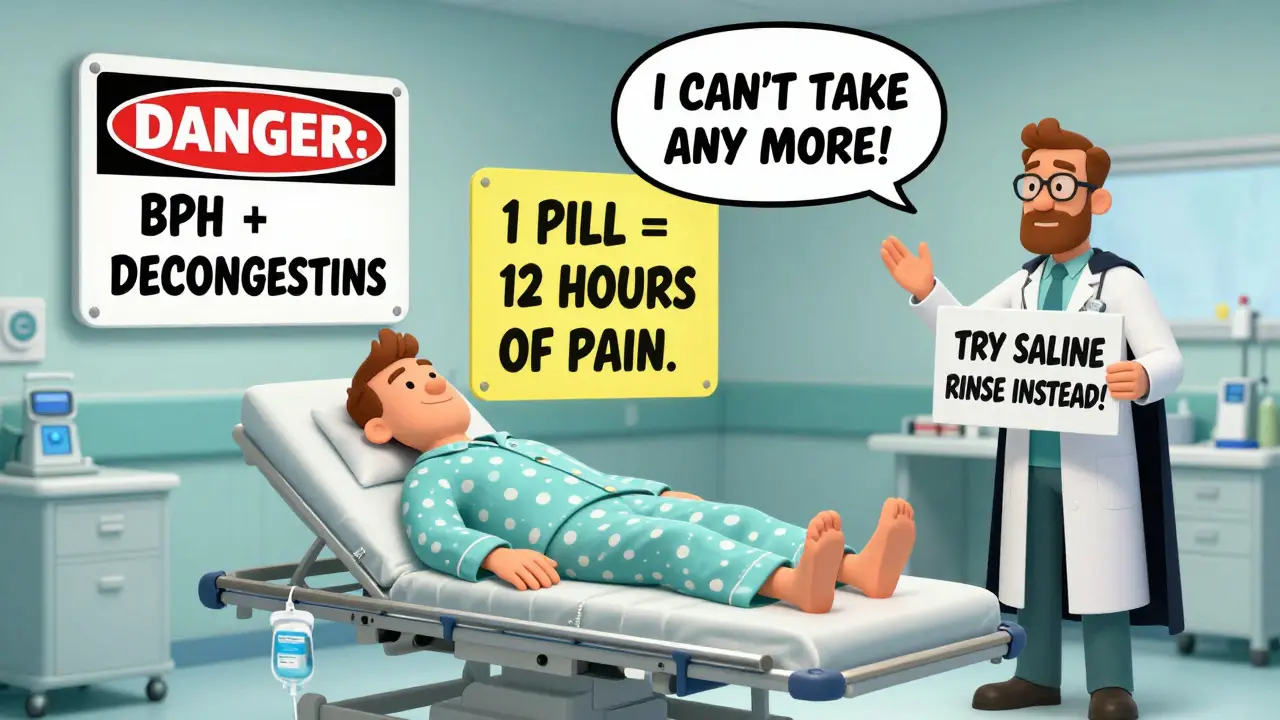
- Saline nasal irrigation: Use a neti pot or NeilMed Sinus Rinse. A 2022 Cochrane Review found it helps 68% of users with congestion. No systemic absorption. Zero urinary risk.
- Intranasal corticosteroids: Fluticasone (Flonase), mometasone (Nasonex). These reduce nasal inflammation. They’re effective in 72% of cases and have no effect on the prostate. Best for chronic congestion.
- Loratadine or cetirizine: For allergy-related congestion. No bladder relaxation. Low risk.
- Steam inhalation: A simple bowl of hot water with a towel over your head. Helps open nasal passages. No chemicals. No side effects.
These aren’t just "alternatives." They’re the recommended first-line options by the American Pharmacists Association and the European Association of Urology.
What If You Absolutely Need a Decongestant?
Some men have no choice. If you have severe congestion and no other option, here’s the protocol experts recommend:
- Never take more than 30 mg of pseudoephedrine in a single dose.
- Do not use for more than 48 hours total. The "48-hour rule" is non-negotiable.
- If you’re on an alpha-blocker like tamsulosin (Flomax), keep taking it. It helps counteract the constriction.
- Start tamsulosin 72 hours before taking the decongestant if you’re not already on it. A 2022 Cleveland Clinic study showed this combination cuts retention risk by 85%.
- Always talk to your pharmacist or urologist first. Don’t rely on OTC labels-they’re often unclear.
And if you’re not on an alpha-blocker? Don’t risk it. The data doesn’t support it.
What’s Being Done About It?
The FDA required updated labeling on all pseudoephedrine products in January 2022. Now, the warning about urinary retention must appear on the box. That helped raise awareness from 28% in 2021 to 63% in 2023. But it’s still not enough.
The American Geriatrics Society’s 2023 Beers Criteria lists pseudoephedrine as a "potentially inappropriate medication" for men over 65 with BPH. The European Medicines Agency is considering restricting sales to men over 50. And Purdue Pharma’s experimental drug PF-06943303-a bladder-selective alpha-blocker-showed 92% efficacy in preventing pseudoephedrine-induced retention in Phase II trials. It’s under FDA Priority Review.
But here’s the gap: 73% of pseudoephedrine sales happen without any pharmacist counseling about BPH risks. That’s a massive safety failure.
Final Takeaway
If you have BPH, your prostate is already working overtime to let urine out. Decongestants don’t help-they fight against you. Pseudoephedrine and phenylephrine aren’t just "side effect" risks. They’re triggers for emergency care.
The safest path is simple: avoid systemic decongestants. Use saline rinses. Use nasal steroids. Use loratadine. Talk to your doctor before taking anything. And if you’ve ever felt like your bladder was full but nothing came out? You already know what this feels like. Don’t wait for it to happen again.
There’s no glory in taking a decongestant. There’s only risk. And for men with BPH, that risk isn’t worth it.




Lakisha Sarbah
February 7, 2026 AT 21:06Wow, I had no idea a simple cold pill could do this. My dad took Sudafed last winter and ended up in the ER. We thought it was just a UTI. This post saved my life. Thank you.
Ashley Hutchins
February 9, 2026 AT 03:29People just don't think about their prostate until it's too late. I've seen too many men ignore the signs. You think you're fine until you're peeing into a catheter bag. It's not glamorous. It's not cute. It's just stupid to risk it. Stop being lazy and use a neti pot already. I'm not mad. I'm just disappointed.
Ariel Edmisten
February 10, 2026 AT 19:28Saline rinse works great. Cheap. Safe. No side effects. Do it daily if you're congested. Easy fix.
Savannah Edwards
February 11, 2026 AT 01:52I grew up in a household where my grandfather would always say, "Don't trust what the pharmacy puts on the shelf." He had BPH and swore by steam and herbal teas. He lived to 92, never had a catheter, and never took pseudoephedrine. I remember him sitting by the window with a towel over his head, breathing in steam like it was a sacred ritual. He said the air was cleaner that way. He was right. I started doing the same thing after my dad's scare. It’s not just about avoiding drugs-it’s about reconnecting with simple, natural ways to heal. The body knows how to breathe. We just forgot how to help it. And honestly? It feels better than popping pills. You don’t just clear your nose-you clear your mind too.
Mayank Dobhal
February 12, 2026 AT 05:53Bro this is why we need better education in India too. My uncle had a catheter for 5 days after a cold. No one warned him. Pharma companies don't care. They just sell. We need awareness. Not just here. Everywhere.
Gouris Patnaik
February 13, 2026 AT 17:39Western medicine is broken. In India, we use tulsi leaves, ginger tea, and steam. No chemicals. No side effects. Why are you trusting American drug companies? Your body is not a lab rat. Wake up. This is cultural decay.
AMIT JINDAL
February 14, 2026 AT 03:47LMAO at people using neti pots like they're monks in a Himalayan cave 🤡 I mean, sure, it's "natural" but have you seen the mold in those things? I had a sinus infection from my neti pot last year. Antibiotics saved me. Sometimes science > superstition. Pseudoephedrine? Just take 15mg. You'll be fine. Chill out. 😎
Paula Sa
February 15, 2026 AT 08:50Thank you for writing this with such care. I’m a nurse, and I’ve seen too many men come in scared and confused. I wish every pharmacy had a little card on the shelf next to Sudafed: "If you’re over 50 and have trouble peeing-this could stop you from peeing at all." Simple. Clear. No jargon. We’re not teaching people. We’re just selling. This post? It’s a gift.
Mary Carroll Allen
February 16, 2026 AT 16:41I cried reading this. My husband had retention last year after taking Claritin-D. He didn’t even know it had pseudoephedrine. The ER nurse said "this happens more than you think." We thought it was just bad luck. Now I check every label. I keep a printed list in my wallet. I’ve sent this to 3 of my dad’s friends. One of them went to his urologist and got on tamsulosin. He hasn’t had a scare since. Please. Share this. Someone’s dad, brother, or grandpa might be one pill away from disaster.
Amit Jain
February 18, 2026 AT 03:09LOL at the "48-hour rule". Like you’re gonna stop yourself. I took Sudafed for 10 days straight last winter. Felt fine. My prostate? It’s a tank. You’re all overreacting. This is why Americans are so anxious. Just chill. Drink water. It’s not rocket science.
Sarah B
February 19, 2026 AT 22:15Stop making this a big deal. Just don't take it if you're old. Done.
Eric Knobelspiesse
February 20, 2026 AT 17:09Okay but here’s the thing nobody talks about-what about men who take pseudoephedrine for ADHD? Yeah, I said it. I’m 58, have BPH, and use Sudafed as a focus aid. My urologist knew. We monitor me. I take tamsulosin daily. I don’t have retention. So yeah, risk exists. But so does smart management. Don’t demonize the drug. Educate the user. There’s a difference. Also, typo: "catheter for days" not "catheter for days." 😅